
Archives
-
Apuntes 99
Vol. 52 No. 99 (2025)This issue brings together a selection of nine articles that critically examine contemporary challenges related to the economy, governance, and social development in Argentina, Chile, and Peru. From the use of machine learning to estimate Peru’s monthly GDP to teacher development policies in Chile as an expression of neoliberalism, the articles explore topics such as the digital transformation of immigrant enterprises, accountability in cooperatives, community narratives during the pandemic, leftist economic ideas in times of crisis, institutional design in regional governments, and legislative dynamics in contexts of political fragmentation. In addition, the issue features the findings of a thought-provoking study on military intimacies and memories of Peru’s armed conflict, engaging in a dialogue between violence and the sexualities of veterans.
-

Apuntes 98
Vol. 52 No. 98 (2025)In this issue of Apuntes, we present eight articles written by 18 authors that explore the role of the State and analyze public policy decisions in Argentina, Bolivia, Peru, Chile, Colombia, and Mexico. Sergio Lagunas, Genaro Aguilar Gutierrez and Brenda Lizeth Soto Pérez adapt chaos theory to analyze the transmission of COVID-19 in Mexico's regions. Irma del Águila examines the proposed presidential reelection in Bolivia, reflecting on processes of institutional change. Sergio Llano Aristizábal and Jennie Peña Escobar apply the Pareto principle to study citizen participation in editing online articles about Colombian government entities. Manuel Damnert-Guardia, Diana Torres Obregón, and Adrián Aiquipa Zavala review the case of the Pasamayito highway to discuss the configuration of modes of urban growth and governance in Peru. Angélica Alvites Baladera studies the experience of Peruvians during Argentina's dictatorship. Carlos Moncada Rojas, Raúl Bustos González, and Elizabeth Sánchez González analyze the impact of cultural diversity on technical-professional education in northern Chile. María José Magliano evaluates the expansion of community kitchens in Argentina. Finally, Patricia Oliart, Mercedes Giesecke, César Guadalupe, and G. Antonio Espinoza present the evolution of educational policies in Peru since 1821.
-

Authoritarianism, popular insurgencies and labour movements in Latin America
Vol. 51 No. 97 (2024)This issue, co-edited by Jörg Nowak (University of Brasília) and Marco A. Santana (Federal University of Rio de Janeiro), consists of articles that provide key elements for reflecting on authoritarianism, popular insurgencies, and labor movements in Latin America.The five contributions analyze urban and rural workers' movements over time and highlight the relationships between the local and the global, in addition to examining the link between collective action and political systems in democracies, dictatorships, and progressive and authoritarian governments. They also help to understand how new activisms incorporate and redefine traditional practices, showing continuity and tactical innovation in repertoires.
-
Afrodescendientes en América Latina y el Caribe
Vol. 50 No. 94 (2023)The objective of this issue of Apuntes is to offer a variety of critical perspectives on the experience of being Afro-descendant in Latin America, highlighting the individual and collective resilience of the diverse black communities in the region. The articles in this special issue challenge traditional historical narratives surrounding these populations and propose new ways of understanding the sociopolitical processes in which they participate. This dossier in Apuntes contributes to the development of Afro-Latin American Studies and provides a deeper understanding of the situation of the Afro-descendant population in the region, as well as their most pressing demands.
-

Apuntes 93
Vol. 50 No. 93 (2023)In this issue of Apuntes, we are pleased to share eight articles that hail from research in Argentina, Chile, and Peru. From diverse disciplinary perspectives including historical, political, and sociological analyses as well as qualitative and quantitative methodological approaches, we examine key issues confronted by our Latin American region in the past two centuries and today.
We open this issue with María Olaya Grau Rengifo´s examination of migrant families´ integration experiences with Chile´s early childhood public program, Crece Contigo, followed by two historical examinations of 19th century events in Peru and Argentina. In the first, Julio César Abanto Chano takes us to the War of the Pacific and the international negotiations that positioned Peru on the international stage. Emilio Fabián Harari and Hermánn Günter Ibach travel back further to the mid-1850s to examine public financing, construction, and the role of federalism in Argentina. Luis Muelle, then brings us back to contemporary Peru with a microdata analysis of segregation in Lima´s public and private high schools. The subsequent two articles analyze power relationships in Argentina and Chile. Natalia Soledad Fernández explores the relationship between youth, the Catholic Church and power in Argentina, followed by a political analysis of social-territorial conflicts, social movements and the salmon industry in Chile by Gonzalo Antonio Delamaza Escobar, Evelyn Arriagada y Mauricio Cortez. We close the issue with Sandra Carillo´s analysis of private school segregation in Peru, on the one hand, and Laura Mabel Zang’s examination of Swiss migration to Argentina in the nearly 100 years between the 19th and 20th centuries.
-

Apuntes 92: Los saldos de la pandemia por COVID-19 en la educación latinoamericana
Vol. 49 No. 92 (2022)Nos complace presentar “Los saldos de la pandemia por COVID-19 en la educación latinoamericana”, el número 92 de Apuntes, revista de ciencias sociales. En ocho artículos de investigación y un breve ensayo introductorio, se examinan diferentes fenómenos y problemáticas educativas que expresan algunos de los cambios que vivieron las comunidades de las escuelas y universidades en todos los niveles, modalidades y sistemas educativos en diversos países de nuestra región a partir de la suspensión de actividades presenciales y el súbito e improvisado tránsito hacia la educación a distancia. A partir de distintos enfoques teóricos, analíticos y metodológicos, y de diversas técnicas de investigación empleadas de manera comparada en estudios de caso desde la investigación educativa, las políticas educativas o la sociología comprensiva, los trabajos examinan las experiencias, percepciones, decisiones, acciones e iniciativas emprendidas por diferentes sujetos, agentes e instituciones educativas en Bolivia, Chile, Colombia, México y Perú tan pronto como fue establecido el confinamiento social en marzo del 2020. || Úrsula Zurita, editora invitada e investigadora, FLACSO-México; y
Leda M. Pérez, directora, Apuntes.
-

Apuntes 91
Vol. 49 No. 91 (2022)Presentamos el número 91 de Apuntes, con artículos dedicados a analizar diversas problemáticas en contextos como el chileno, peruano y colombiano. Además, esta edición mantiene el enfoque interdisciplinario y reúne contribuciones que parten de investigaciones que se sirven de tanto de metodologías cualitativas como de aquellas propias de la Economía y de la Historia. Así pues, los temas abordados en este número son: los determinantes e impactos de desastres naturales y emergencias sanitarias, el desarrollo histórico de un sector como el turismo, y el de una disciplina como la Ingeniería, la percepción de los viajeros extranjeros sobre el universo sociocultural de las comunidades negras, la medición de la calidad de la educación, y el acceso al crédito por parte de MiPyMEs. Finalmente, el número cierra con una reseña que llama a la reflexión en torno al sistema de pensiones en América Latina.
-

Género, cuerpo y economía: rutas discursivas y sociales
Vol. 49 No. 90 (2022)En este número de Apuntes, titulado “Género, cuerpo y economía: rutas discursivas y sociales”, se exploran, a través de siete artículos y dos reseñas, las diversas formas en las que se han experimentado y experimentan las conceptualizaciones de género en América Latina, y cómo estas inciden en las vivencias por medio del cuerpo, las actividades laborales y las relaciones sociales. Este nuevo número cuenta con miradas históricas, análisis de contextos actuales y perspectivas económicas para abordar y comprender tan complejas realidades.
El primer artículo de este número, escrito por Seid, reflexiona, a partir de análisis de entrevistas biográficas, en torno a la desventaja comparativa de mujeres de la clase obrera de Buenos Aires en la actualidad. Desde una perspectiva histórica, Valobra y Queirolo revelan los costos socioeconómicos asociados con comportamientos deslegitimizados como el divorcio para las mujeres en la primera mitad del siglo pasado, también en Buenos Aires. El tercer artículo, escrito por Merino y Jara Reyes, nos devuelve al siglo XXI compartiendo la experiencia del ciberactivismo feminista en Chile y algunos de los logros en la lucha contra el acoso sexual callejero en ese país. Así como el acoso sexual en contra de las mujeres se relaciona muchas veces con la sexualización de sus cuerpos, Scharagrodsky explora en su artículo cómo se construyó en Argentina una masculinidad idealizada a partir del análisis de las tapas de la revista El Gráfico. Luego, Garcés, Leiva y Comelín nos muestran cómo la interseccionalidad de género, condición de migrante y rubro laboral posiciona a trabajadoras del cuidado que migran entre Bolivia y Chile en situaciones de alta vulnerabilidad y precariedad. La sección de artículos se cierra con dos contribuciones desde la economía. Por un lado, Nuñez muestra que la obesidad en mujeres —a diferencia de aquella que se da en hombres— sirve como una barrera para el empleo y afecta negativamente el salario en pleno siglo XXI; y, por otro lado, De Carvalho examina desde un enfoque de pobreza multidimensional cómo las mujeres en Brasil experimentan mayores índices de escasez, en parte por su condición de género y por las diferenciadas oportunidades socioeconómicas a su alcance. Por último, este número de Apuntes cuenta con dos reseñas: la primera fue escrita por Sharie Neira sobre el libro de Jules Falquet Imbricaciones: Mujeres, raza y clase en los movimientos sociales; y la segunda fue preparada por Ailin Basilio sobre el libro de Natalia Milanesio, El destape. La cultura sexual en la Argentina después de la dictadura.
-

Times of COVID-19 in Latin America: Perspectives from the social sciences
Vol. 48 No. 89 (2021)It is with great pleasure that we present the 89th issue of Apuntes, "Times of COVID-19 in Latin America: Perspectives from the social sciences". After a long consideration and given the critical times we are currently experiencing, the editorial team decided to put together a thematic issue dedicated to the analysis of COVID-19, health, and caregiving. We present six articles that employ diverse disciplinary approaches to analyze the current and future challenges posed by the pandemic in various countries of our Latin American region.
In her introductory essay, Karina Ramacciotti, a historian and researcher at the National Scientific and Technical Research Council (CONICET) in Argentina, and the curator of this special issue, discusses the perspectives presented in the various articles. The issue finishes with a review of the second edition of Marcos Cueto’s El Regreso de las Epidemias. Salud y Sociedad en el Perú del Siglo XX (The Return of Epidemics. Health and Society in 20th Century Peru).
From historical studies to analyses of social policies and with the cross-cutting theme of cities before and after the pandemic, these articles demonstrate what Dr. Ramacciotti alludes to in the title of her introduction: “When what seemed far away comes very close. Epidemics and caregiving in the intersection of the past and the present.” What the current situation clearly reveals—which provide the theme for this special issue—are the outstanding debts of our societies, their future challenges, and role that the social sciences can play.
-

Apuntes 88
Vol. 48 No. 88 (2021)In this 88th issue of Apuntes, we are pleased to share with you six articles. These original works explore diverse issues related to internal migration, gender, social welfare and child health.
The first two articles, one from Mexico (José Luis Suárez Domínguez and Alim Getze Mani Eden Vásquez Feria) and the other from Chile (Macarena Trujillo Cristoffanni and Paola Contreras Hernández), respectively, derive from their analyses centered in university-related settings. Suárez and Vásquez focus their examination the relationship between university-led migration and cultural capital. For Trujillo and Contreras, the object of study is gendered violence in the university.
Using a gender and relational lens, Nadia Ledesma takes us to Argentina in the decade between 1930 and 1940 for a historical analysis of the medical establishment´s views on birth control, exploring the differentiated experiences among populations. Carla Zibecchi and Vilma Paura, also from Argentina, review the state of the art of welfare regimes in that country. The last two articles from Peru discuss social and economic determinants of children´s mortality on one hand, and the impacts of state-led programming on child health and nutrition, on the other.
Finally, the book reviews that accompany this issue include Alberto Vergara´s review of Charles Walker´s and Liz Clarke´s historical analysis of a lesser known 18th century Peruvian revolutionary leader, Juan Bautista Tupac Amaru. Eduardo Torres looks to the future of governance and climate change in his review of Ros Ibarra ´s edited volume on the subject.
-

Vol. 47 No. 87 (2020)
It is with great pleasure that we present the 87th edition of Apuntes. Social Science Journal. In this issue we share eight research articles from the Latin American region that examine topics on economics, history, social, political and educational studies. These include contributions from Argentina, Chile, Mexico and Peru.
The first three articles are linked by a concern about the movement of people and their socioeconomic and political placements and/or positioning in space and time. The following three analyze power dynamics from different vantage points: one, from a historical perspective, on sexual and reproductive rights in the context of conservative institutions in Argentina; another examines local, community collaboration and good governance in promoting ecotourism in Mexico; and finally, we include a piece that analyzes Argentina´s decision to classify yerba mate as a natural resource, thus stimulating population growth in Misiones Territory. Finally, we close this issue with two Peruvian case studies. The first on macro-fiscal policies, and the other, on innovation and employment.
-
Apuntes 86
Vol. 47 No. 86 (2020)This issue of Apuntes includes eight articles. The first examines interest among part of the Peruvian elite in modernizing public education at the beginning of the 20th century. The next article identifies the characteristics of cooperativism that make it an appropriate space for youth training and labor inclusion in Argentina. The third study provides a multidimensional measure of youth poverty in five regions of Brazil; the most important indicators found were access to the internet, educational level, access to a sewage network, and garbage collection. The fourth article analyzes the impact on the Peruvian textile industry of the 1929 textile crisis and the importation of Japanese textiles in the 1930s. In turn, the fifth reflects on the results achieved by Peruvian students in science, math, and reading tests in the PISA 2015 round; the author emphasizes the impact of socioeconomic and socioeconomic composition on academic performance. The sixth article debates the relative merits of open and closed lists for the election of women, describing different systems used in congressional and municipal elections in Peru, and examining gendered disparities between Lima and the provinces from a gender perspective. The seventh study measures the decent work variable in self-managed cooperatives in Costa Rica. Finally, the eighth article estimates the impact of the Pension 65 program on per capita expenditures on food in Peru in 2017-2018, finding a significant increase in food spending in the households that benefit from the program.
-

Apuntes 85
Vol. 46 No. 85 (2019)The main topic of this issue of Apuntes is tourism in Latin America. Mark Rice, a specialist on the subject, is the author of the first article which provides a historical overview of academic debates on tourism and its consequences. The second and third articles, respectively, employ a historical perspective to analyze state promotion of tourism in Chile between 1929 and 1959, and the development of public policies to foment tourism in Peru between 1930 and 1950. In contrast, the fourth article seeks to understand tourism as a rehumanization tool in the favelas of Rio de Janeiro in Brazil while the fifth presents a narrative analysis of the vision of the Museo Inti-Ñan regarding the equator and geodesic monuments. The next article analyzes transformations of tourism resulting from efforts to museify the city, establishing a nexus between the culture of consumerism and tourism. Finally, the issue ends with two articles on other subjects: one analyzes diversification projects to complement viticulture in Mendoza, Argentina between 1901 and 1930, while the final article demonstrates how improvements in state institutionalization in China were a determinant factor in that country’s economic success.
-

Apuntes 84
Vol. 46 No. 84 (2019)This issue of Apuntes concentrates primarily on migration. The first article examines the way that deportation of Mexican immigrants from the US. inflicts different forms of suffering on both the immigrants and their families, while the second conceptually discusses the social suffering associated with return migration. The third study evaluates post-deportation mobility strategies employed by Mexican emigrants in Oaxaca. Using a different approach, the fourth article explores the suffering of Cuban migrants in Ecuador with emphasis on the social, economic and legal discrimination that exists despite provisions to the contrary in the Ecuadorian constitution. Similarly, the fifth study addresses the relationship between humanitarianism and migratory control in Argentine international migration policies, discussing the processes of ambivalent categorization of immigrants as victims and/or threats. The sixth article on migration focuses on the policies of states of origin towards their emigrants and provides a descriptive panorama of the options chosen by Latin American and Caribbean countries. Finally, the last paper aims to demonstrate the possible existence of opportunistic political-economic cycles in current and capital expenditures in the municipalities of the state of Rio Grande do Sul from 2009 to 2016. DOI: http://dx.doi.org/10.21678/0252-1865-00460084
-

Apuntes 83
Vol. 45 No. 83 (2018)This edition of Apuntes starts with an article on agricultural initiatives in La Pampa (Argentina) between 1952 and 1959 and how these were part of a pre-existing official agenda, defined in the context of an agro-ecological crisis. This is followed by an ethnographic and qualitative study which analyzes intergenerational relationships in the care of women and children during pregnancy, birth, and puerperium in Molinos (Salta, Argentina). Then, in the framework of the new conception of social tourism that is expanding on the international level, comes research evaluating the results of Argentine public policy in this sector a decade after it was established. The following study describes therapeutic itineraries in the search of healthcare and rehabilitation for persons with disabilities in Argentina and Chile based on the results of two independent qualitative studies. The purpose of the next article is to analyze ideas, definitions, and practices related to the “emergence” of rehabilitation of persons with disabilities in Argentina between 1940 and 1960. The following analysis provides evidence that level of education seems to be the principal factor determining the choice of Brazilian young people between formal and informal work. Finally, the last article explores rural well-being in Argentina from a historical perspective, concentrating on the perspective of the first residents of the agricultural colony of Florencio Varela, Buenos Aires. Finally, this issue of Apuntes closes with the traditional book review section.
DOI: http://dx.doi.org/10.21678/0252-1865-00450083
-

Apuntes 82
Vol. 45 No. 82 (2018)Apuntes 82 includes articles on the migratory cycles of Argentine rural workers, the role of technology transfer in local development (the Argentine case), an analysis of research groups and their interaction with Brazilian enterprises, an examination of the structural reform of social security in Uruguay, a study of the effectiveness of educational reform during first stage Peronism in the interior of Argentina, and a study of the relationship between the university and its local environment based on a review of the policies of the national universities of Quilmes and Lanús, Argentina. The traditional book review section rounds out this issue. DOI: http://dx.doi.org/10.21678/0252-1865-00450082
-

Apuntes 81
This issue of Apuntes includes articles on industrialization processes and microenterprises in Brazil, renewable energies and public policies in Latin America, agricultural research in Bolivia, and a proposal for integrating aboriginal legal systems into Mexican legal institutions in accordance with the country’s constitution. As is traditional, the last section of this Apuntes consists of books reviews.
-

Apuntes 80
This issue of Apuntes concentrates on Peru, Argentina, and Brazil. It contains studies about the development of a new working class and the vicissitudes of foreign policy in Brazil and Argentina, and about Catholic youth and public health in Argentina. There are two articles about economy, society, and history in Peru: one analyzing the so-called ‘NEET’ (those not in education, employment or training) phenomenon, and another reviewing relations between society, science, and technology through a study of the life of Peruvian intellectual Mariano Eduardo de Rivero y Ustáriz.
-
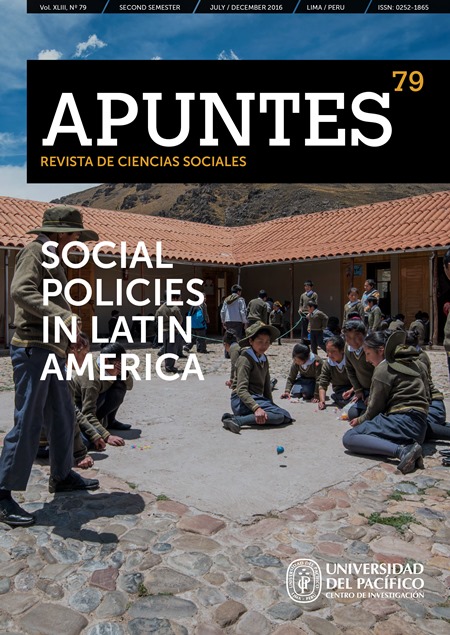
Apuntes 79: Social policies in Latin America
This issue of Apuntes contains articles about educational policies, pensions, health and nutrition, and worker managed enterprises. Apuntes 79 analyzes the cases of Argentina and Peru, in addition to comparative studies on Chile, Colombia, Mexico, and Peru.
-

Apuntes 78: Pensions Systems in Latin America
The articles in Apuntes 78 analyze various aspects of changes in contributory and non-contributory pension systems in Peru and Latin America. The objective is to examine the impacts of these systems on pensions and coverage, as well as on inequality, poverty, fiscal cost, labor markets, and savings, employing both simulations and projections. This issue includes a study on the relationship between old age and poverty in Latin America and studies based on the Argentine and Peruvian experiences.
-

Apuntes 77: Agriculture and development
The central theme of Apuntes 77 is the development of agriculture in terms of the efficient use of natural resources, the expansion of agricultural frontiers, and the commercialization of ecological products. The issue includes articles that analyze Peruvian agriculture from the economic and business perspectives. The section on other topics features an interesting analysis of the development of electrical systems in the Valle del Paraíba, Brazil in the mid-20th century.
-
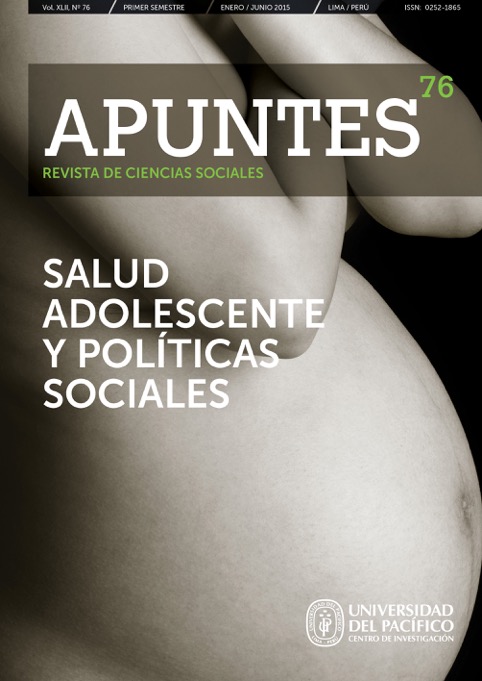
Apuntes 76: Adolescent Health and Public Policies
The central theme of this issue is adolescent health. The articles analyze government policies and risk behavior among adolescents from ethnographic and econometric perspectives. The former perspective is employed to study government interventions in urban and rural zones with the aim of improving sexual and reproductive health in Peru and Argentina. The latter is used to verify the importance of cognitive and non-cognitive abilities in risk behavior among adolescents in Peru. In addition, as usual, this issue includes articles on other subjects, including the modes of internationalization of two Argentina drug multinationals, and the regulatory framework for Brazilian multinationals (1951-1967).
-

Multinationals and "Multilatinas"
The central theme of Apuntes 75 is the internationalization of Latin American enterprises from a historic perspective. The articles include sound research which discusses the role of management, type of property, government policies, and the influence of multinationals on the internationalization process in Latin America.


.jpg)

