
Archives - Page 2
-
Politics and Public Service
The articles in this issue explore the role of government officials and institutions in Latin American politics. Comparative analysis is used to study the role of international organizations in the formulation of government policy and development projects; the impact of political affiliation in public management; the role of local officials in the implementation and redesign of public policies; and the socio-professional profiles of public servants.
-

Environment and Natural Resources
This issue approaches the interaction between natural resources and economic development from a multidisciplinary perspective. The articles in this issue analyze the impact of maximum capture limits for fisheries; study the problems and possibilities in water basin management in northern Peru and Mexico; and analyze the interaction between biodiversity and the creation of value chains; possibilities for tourism in protected areas as a source of economic development; and the behavior of Chinese mining companies in relation to environmental protection.
-
Education: Quality and Processes
This issue of Apuntes explores issues that are important for the formulation of public policies in the educational sector from a variety of perspectives. Articles analyze access to and quality of university education; the impact and use of free time by parents for the education of their children; participation of civil society organizations; the interaction between teacher training and the distribution of teaching materials; and PISA examinations in Latin America.
-

Trade and Political Relations between China and Latin America
Most Latin Americans think that China is the country with the most influence in the region, after the United States. This perception is reinforced by commercial data showing that China is the second-largest export market for the majority of countries in the region. But what do we really know about the political and commercial impact of China on our region? In this issue of Apuntes, the authors study the differing impact of Chinese economic growth in various Latin American countries; the challenges that this poses for traditional U.S. hegemony; the political and economic implications of free trade agreements and arbitration treaties between Latin American countries and China; and the growing importance of Chinese banks and its financial system in the region.
-
Firms and Business Groups
Latin American enterprises and groups have undergone a process of consolidation and expansion in recent years. The articles in this issue of Apuntes employ historical and political science approaches to study Latin American economic groups’ spheres of influence, sources of financing, corporate networks, international strategies, behavior in the area of corporate social responsibility, and the role that family enterprises play in a globalized economy. The cases of Argentina, Brazil, Chile, and Colombia are analyzed.
-
Health and Public Policies
This issue of Apuntes includes articles on health and public policies in Peru, Nicaragua, and Argentina. The studies on Peru analyze the effectiveness of strategies to combat child malnutrition and study medical students’ university educations and their learning experiences during their work in the Rural Urban Marginal Health Service (SERUMS). The article on Nicaragua analyzes improvements in the performance of health sector workers. Another study reviews the publication Archivos de la Secretaria de Salud Pública de Argentina between 1946 and 1950 and the role it played in disseminating information on Argentine medical science. The final article, on the process of creation of the World Health Organization in the context of the start of the Cold War, examines the legacy of this United Nations agency.
-

Mining and Social Impact
The articles in this issue: Investigate gender and social inequality resulting from large-scale mining in Peru; Study the consultation of indigenous peoples and its evolution as a political negotiating tool in Peru and Guatemala; Review one of the recent transformations that has taken place in Peru in recent years, the reorganization of coercive power and security; Analyze the impact of mining activity on Peruvian cities and the effects it has had on urban areas throughout history; Study the decline of the nationalist model in the Mexican mining industry, as well as the impact that the expropriation of oil companies in 1938 had on diplomacy and public opinion in South America; Analyze the long-term impact of the mining mita and its effects on currently-existing districts of Peru where it once was once practiced.
-

Apuntes 67
The articles in this issue: Analyze the political influence and relevance of the Peruvian Presidency of the Council of Ministers (PCM); Investigate Aprista proselytism and propaganda activities in Argentina in the 1930s; Examine the economic cost of a natural disaster by estimating the change in consumption prompted by the event; Analyze the influence of the Human Development (HD) approach on Peruvian public policy agendas; Discuss Argentine public policies and national and provincial legislation aimed at guaranteeing the territorial rights of indigenous communities in the province of Jujuy.
-
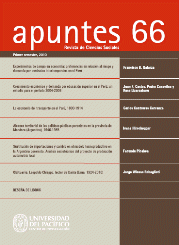
Apuntes 66
The articles in this issue: Analyze the effect of education and risk aversion in the selection of productive projects that involve intertemporal contracts in rural Peru; Study the increased demand for higher education in Peru and how this has been incentivized by the recent economic expansion; Review the transport economy in Peru in the period 1800-1914, and the positive and negative effects that the introduction of railroads on producers, traders, muleteers, cattle herders, agriculturalists, and veterinarians; Investigate the territorial reach of Peronist health and education policies in the province of Mendoza, Argentina in the years 1946-1955, and the actual effects of these policies; Demonstrate how a set of heterogeneous factors (sectoral regulations, public capital, government propaganda, private businesses, officials, workers, and users) were involved in implementing the Peronist project in the 1950s.
-
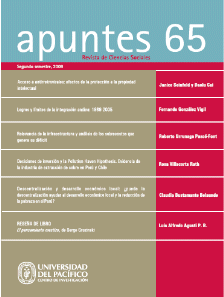
Apuntes 65
The articles in this issue: Measure the impact of intellectual property protection policies on the price of antiretroviral drugs, and access to these, in 59 countries; Analyze the achievements and limitations of the economic integration process in the Andean Community of Nations subregion during the period 1989-2005; Demonstrate the favorable impacts of public service infrastructure on the economy and the resulting cost excess when infrastructure is poor; Examine whether environmental legislation is one of the factors that influences decisions by the copper mining industry in Peru and Chile; Examine the connection between decentralization, local development, and reduction of poverty to discover whether decentralization can promote local economic development in Peru.
-
Apuntes 64
The articles in this issue: Use the specialized module of “income of self-employed worker in non-agricultural family enterprises” from the Peruvian National Household Survey to estimate a set of empirical models and explain the differences in levels and rates of real income growth in such enterprises; Analyze the credit boom in Peru using a regime change model; Test the hypothesis that improvements in objective variables (salary, employment, inflation, etc.) have no significant effect on perceptions of subjective well-being, using data from Lima (1994-2008); Analyze the commercial credit requirements of the Peruvian banking system; Study decisions on borrowing made by Peruvian businesses during the period 2001-2007 and their determinants; Evaluate the strengths and weaknesses of the Peruvian economy when confronting external shocks, such as the U.S. recession.
-
Apuntes 63
The articles in this issue: Present some of the results of an analysis of the budgetary process for Lima’s health sector to discover the institutional limitations that limit the effectiveness of sectorial spending; Analyze public environmental investment by local and regional governments in Peru to determine the interest of these institutions in promoting environmental sustainability; Identify the main factors that lead to households slipping into and out of extreme and non-extreme poverty in Peru (2003-2006); Investigate how a professional career can influence an individual’s degree of egoism; Demonstrate that the Value at Risk (VaR) measuring tool can be improved by incorporating a liquidity factor, as well as applying liquidity adjusted VaR methodology to a sample of stocks on the Lima stock exchange.
-
Apuntes 62
The articles in this issue: Seek to find the most effective determinants in reducing child and neonatal mortality in Peru; Analyze the relationship between the coverage of social expenditures and fiscal policy during different phases of the economic cycle, with a view to reducing the vulnerability of Peruvian households; Propose the creation of a social inclusion fund, the activities of which would be determined by careful analysis of social gaps, by integrating 49 social programs in Peru; Evaluate the possibility of Peru achieving the First Millennium Goal related to the eradication of hunger.
-
Apuntes 60 - 61
The articles in this double issue: Provide an empirical analysis of the paradigm of the rational man; Analyze the effects of Law 27143, Law for the Temporary Promotion of National Productive Development, in terms of expenditures and the cost to the state and society of government purchases of medications; Examine the performance of regional governments from an economic perspective through the construction of various indices of efficiency in expenditures for six specific functions; Endeavor to improve the understanding of poverty in Peru, taking into account subjective perceptions of welfare by households; Analyze the level of maturity of the Madre de Dios forest cluster and evaluate the possibilities for its expansion in the context of climate change; Study the sustainability of microfinance institutions; Analyze the factors determining optimum levels of debt among mining companies in Peru.
-
Apuntes 58 - 59
The articles in this double issue: Explore the effect of remittances, pensions, and care provided by Padomi (EsSalud) on the economic security and welfare of senior citizens; Analyze the vertical structure of Peruvian political parties, which do not have deep roots in society, suggesting that the study of Peruvian politics requires its own decentralization; Examine the so-called economy of innovation, which has become a clearly identifiable competency in specialized economics; Argue that there were two “Marxes,” one who envisioned a “socialism of only one enterprise” and another who imagined the ultimate utopia of communism; Investigate the impact of free trade agreements in Latin America; Explore the impact of the Peruvian Program of Market Creators; Present the principal theoretical contributions relating to the creation of more inclusive growth that would reduce poverty in Peru.
-

Apuntes 56 - 57
The articles in this double issue: Study interactions between the Peruvian government, firms, and international institutions in developing the energy market as well as government management capacities; Analyze the procyclical character of strikes in the Peruvian private sector; Investigate the implications of household decisions regarding child labor, and how these affect the process of economic development; Analyze interactions between majority shareholders, managers, and administrators of enterprises in Peru; Reflect on broad issues in the development of economics and the other social sciences through an analysis of the use of categories such as alienation, fetishism, and colonialization; Review existing evidence on the impact of adopting inflation targeting (IT); Examine the possibilities for developing a strategic environmental assessment process in Peru.
-
Apuntes 55
The articles in this issue: Investigate how Peru can take advantage of the opening to trade that began in the 1990s, leaving behind the previously high levels of protection for national industry; Model an inflation density forecast framework that closely resembles policymakers’ actual behavior; Analyze theoretical perspectives and preliminary evidence of collective models of household decision-making and resource allocation; Develop three models for the analysis of fishing for carachi (Orestias agassii) in Lake Titicaca (Peru-Bolivia) for the sustainable management of fishing in this region.
-
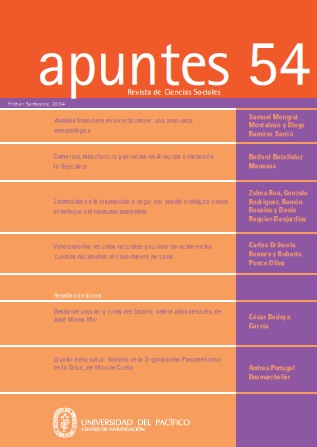
Apuntes 54
The articles in this issue: Propose a methodology for identifying the most appropriate tools for financial analysis; Analyze the impact of changes in national trade policies in commerce, manufacturing, and service sectors in Arequipa immediately after independence; Estimate willingness to pay (WTP) for ecological panela from a sustainable consumption approach; Employ the net price method to estimate the depreciation of natural capital and the real net national product of Peru’s mining sector during the period 1992-2001.
-
Apuntes 52 - 53
The articles in this double issue: Explore the principal characteristics and stylized facts of exchange rate behavior in Peru and Central Bank interventions in the foreign exchange market; Conclude that in Chile, contrary to Barclay (1987), ex-dividend day stock prices are not seen to fall; Highlight the importance of social interests during transitions to market economies, when economies move from the crisis stage to the consolidation of the reforms; Employ a global perspective to study how the informal economy affects multiple forms of innovation; Establish the basic criteria for the evaluation of credit risks derived from exchange risk in a partially dollarized economy; Use a capacities approach to analyze certain subjective indicators for evaluating the welfare of coffee producers in Peru and Colombia.
-
Apuntes 51
The articles in this issue: Assess the pros and cons of a basic income grant and estimate the financial cost of paying a similar benefit to specific groups in Peru; Provide an approximation to a deeper analysis of Peru’s trade negotiation processes, with the goal of developing a medium-term negotiation strategy; Survey three methods for testing the weak form of market efficiency: the autocorrelation coefficient, the variance ratio, and the lead-on-the-lag regression; Analyze the proliferation of preferential trade agreements in the Americas, and the changes that have taken place in integration models and in the countries leading integration processes since the 1960s.
-

Apuntes 50
The articles in this issue: Estimate the impact of health status on the productivity of senior citizens in Peru; Provide a critical socioeconomic analysis of the Biosecurity Protocol on issues related to agrobiotechnology and biodiversity; Compare the U.S. command and control system in wireless communications and the property rights approach, recommending the latter for Latin America. Present a methodology for calculating the structural balance of the public sector and its application to the Peruvian economy during the period 1990-2002; Analyze the health and sexual and reproductive rights of Asháninka women in the Ene River region.
-
Apuntes 49
The articles in this issue: Analyze the effects of trade policies on the location patterns of foreign direct investment (FDI) by country and sector; Evaluate the role of foreign trade in the economic structures of the United States and Mexico within an integration process such as existed when the North American Free Trade Agreement was signed; Examine the complaints of Peruvian producers of vegetable cooking oil that Argentina is subsidizing the oil it exports to Peru, and their demands that a duty be imposed on these imports; Analyze dollarization and its effects on the robustness of the Peruvian financial system; Present a methodology for evaluating the impact of an advertising campaign as part of a broader social marketing strategy to promote a nutritional supplement in Bolivia.
-
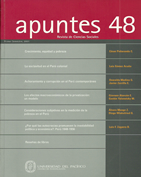
Apuntes 48
The articles in this issue: Analyze, in the general terms, the issue of economic growth on the world level and, in more detail, the case of Peru; Summarize and evaluate the importance of the slave system in Colonial Peru, which not only affected Africans but also Asians, Moors, and indigenous people; Examine corruption during the government of president Alberto Fujimori, employing the hypothesis of achoramiento, understood as a strategy for social mobility that essentially violates ethical and juridical norms; Study the macroeconomic effects of the privatization of public companies; Analyze subjective considerations in measuring poverty in Peru in order to define an antipoverty strategy; Examine Odria autocracy (1948-1956) as an example of how autocracies, in contrast to democracies, promote instability in the rules of the game and the application of populist policies.
-

Apuntes 47
The articles in this issue: Investigate whether the benefits of Peruvian economic growth in the early 1990s will be experienced by the whole population; Analyze the behavior of private savings in Peru in the last 46 years and the determinants of this variable in economic policy; Empirically analyze the relative technical efficiency of enterprises operating in the electrical energy distribution sector in Peru in the period 1995-1998; Update the debate on the Peruvian fiscal sector between 1884 and 1992, emphasizing some previous historiographic errors; Provide a sectoral analysis of Spanish investment in Latin America; Examine some of the experiences in information and knowledge sharing among MERCOSUR firms and the role of government in ensuring their success.
-
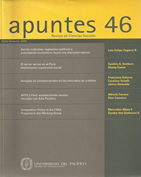
Apuntes 46
The articles in this issue: Provide a theoretical discussion of how the creation of rules of the game is affected by the characteristics of the political market, in particular by collective action and the nature of the political regime; Provide a brief overview of the participation of the non-profit sector in the Peruvian economy and society, analyzing the main advantages and limitations of private non-profit organizations as agents of development; Evaluate three non-conventional mechanisms established by formal and informal lenders to tackle the problem of asymmetric information; Review new relationships between Peru and the Asia-Pacific region, including APEC; Analyze competition policy in the FTAA.

.jpg)

