
Archives - Page 3
-
Apuntes 45
The articles in this issue: Propose a new instrument for assigning resources to fighting poverty through the construction of a New Poverty Map, which takes into account consumption deficits, levels of inequality, and the severity of poverty; Study the oligopoly existing among Peruvian pension providers (AFP) and their high profit margins given the lack of competition; Apply game theory to the controversy between the Electrical Fees Commission and electricity distribution companies in metropolitan Lima; Investigate the always complex Peruvian civil-military relations through an analysis of the naval rebellions in Callao in 1932 and 1948; Explore how the Andean languages, Quechua and Aymara, provide keys to understanding the symbolic conceptual world of the Andean peoples; Analyze the current world situation and reflect on possible solutions to the crisis.
-

Apuntes 44
The articles in this issue: Present the most important applications of auction theory to infrastructure concessions in Lima, in 1999-2001; Study the growth of small garment enterprises in Lima, in 1980-1997, and especially those that have the accumulation capacity over time; Examine how the Strategic Decisions Group (SDG) process enables the development of alternative strategies, their evaluation, and the ability to make the best choice for a given company; Explore the connection between Harrod’s economic dynamics and the Keynesian paradigm; Seek to explain why the Andean Community member states have both delayed the completion of Andean Free Trade Zone and have repeatedly postponed the deadline for creating the Andean Customs Union.
-

Apuntes 43
The articles in this issue: Present an application of the input-output model to estimate linkages between production sectors and multipliers of investment, employment, and the external sector in the Peruvian economy; Discuss the issues involved in the current legal framework for the non-profit sector in Peru, and the reforms needed; Describe the main characteristics of the Peruvian non-profit sector; Discuss the results of a survey of 170 Peruvian opinion-makers, from various professions, about the most serious problems facing Peru; Analyze two experience in regulating public services in Peru, electricity and potable water.
-
Apuntes 42
The articles in this issue: Explain why there was no large-scale Japanese private investment in Peru in the 1990s, stressing the effects of Peruvian policies and of the Japanese strategy centered on investment and export platforms; Discuss the European Union integration process, with emphasis on financial aspects, questioning whether the establishment of a common currency is an indispensable objective, at least from the economic point of view; Introduce the category of achoramiento to characterize the personal and institutional behavior that constitute a new strategy for social advancement; Explore texts in Quechua by chroniclers and colonial authors and analyze their representations of the concepts of soil fertility, rest, and fallow; Study investment in resources for value creation from a portfolio approach; Examine Peruvian regulatory policies since 1993, when the government initiated a new period of structural reforms and liberalization; Employ multinomial logit (MNL) models to verify the heterogeneity of the urban informal employment sector in Lima and the significance of informal wage work for women in Lima.
-

Apuntes 41
The articles in this issue: Address the significance of the recent global trends toward the liberalization of foreign direct investment (FDI) in Latin America, analyzing the cases of Brazil, Chile, Peru, and the Andean Group; Provide an analysis of the strategic balance in the Asia-Pacific region, one of the areas with the greatest competition and cooperation in the post-Cold War period; Explore the relationship between the environment and development and demonstrate that a healthy environment is the foundation for long-term development; Demonstrate how a system built on certain types of decreasing (or at least non-increasing) marginal-productivity production functions lead to a value in the final total volume of consumer goods that is equal to the product of a mathematical factor times the value of the stimuli; Discuss classic economic theory and Marxist growth theory, demonstrating that there is theoretical-analytical unity, continuity, and progression in the theories of the Physiocrats, Smith, Ricardo, and Marx; Analyze articulation, exchanges, and the need for alternative monies in a regional economy, using the case of Cusco.
-
Apuntes 40
The articles in this issue: Propose a methodology for analyzing the effectiveness of social programs for childcare and transfers on the decision to work by mothers, taking into account incentive-effects; Propose a strategy for government activities to promote equal access to basic social services and opportunities for social insertion; Examine the regulatory role of state institutions in the area of public services during the era of Fujimori, arguing that this is an improvement over the era of publicly owned companies; Discuss and recommend alternative tax policies that would allow Peruvian exports to be more competitive; Review the impact of the economic emergency in East Asia and its impact on international relations; Examine the populist tradition in the political development of Peru in the last 50 years; Evaluate some of the implications of the Convention on Biological Diversity from the perspective of political economy.
-

Apuntes 39
The articles in this issue: Propose a new dictum or rule for the methodology of theory modeling; Present the preliminary results of an international research project on whether and to what extent flexible automation (FA) has spread to developing countries; Analyze recent foreign investment in Peru in the framework of a new development strategy in Peru; Note the need for national and international policy agendas to provide an integrated vision of the social and economic dimensions of development, and explore the impediments and challenges brought to light by recent discussions on these issues; Provide a social history of street children in Lima, and a detailed description of their lives in the late 1980s; Investigate the relationship between political violence and liberal principles in Peru during the first decades of the Republic, 1827-1845; Investigate political discussion at the time of independence in Peru (1820-1821) through an analysis of theatrical productions of the time.
-
Apuntes 38
The articles in this issue: Discuss the impact of expectations on the “style of theorizing about macroeconomics”; Review the intellectual background of Robert Lucas, who received the Nobel Prize in Economics in 1995 and went from being a historian to the most important economist of the 20th century; Discuss the link between political liberties and economic development, reviewing the approaches of numerous studies on the subject; Employ the ideas of John Paul II in analyzing Catholic ethics and capitalism in Latin America; Explore whether the exchange rate in Peru is lopsided or whether exchange rate shifts occur in response to long-term factors, be they internal or external, that have reduced the rate to lower levels than those of the 1980s. Propose new ideas about social policies with an emphasis on the application of economic-theory tools to the health sector; Analyze Walras’ Law, which is often presented as if it reaffirms the impossibility of imbalances in a single market, presenting an alternative version that corrects its errors; Review and analyze the book After Babel by George Steiner.
-
Apuntes 37
The articles in this issue: Argue that, in principle, there is no fundamental conflict between economic growth and equity; Evaluate the contributions of the four National Living Standards Surveys (ENNIV) to the research and design of economic and social policies in Peru in the period 1985-1994; Analyze the factors that influence demand for child healthcare in Peru on the basis of an empirical analysis; Employ factorial and cluster analysis techniques to categorize the departments of Peru in decreasing order of development, demonstrating sharp differences between them; Study the sources and components of Peruvian economic growth in the period 1950-1990; Analyze U.S. thinking on international relations and the changes that took place at the end of the 1980s that led to new theoretical approaches; Review the work of the United Nations, in light of its Charter, in areas such as security and international peace as well as development; Examine the financial performance, liquidity, and profitability of small enterprises.
-
Apuntes 36
The articles in this issue: Analyze the capacity of the state to manage large-scale organizations, an organizational technology that is particularly scarce in poor countries; Discuss issues such as the appropriate institutional framework for the functioning of the market, assuring economic growth, and the political consolidation of neoliberal reforms; Discuss differing aspects of the importance of technology to productive and entrepreneurial development in Latin America and the Caribbean; Analyze the real exchange rate in Peru during the Stabilization Program (1990-1994); Provide a comparative analysis of political processes in Peru and Italy and their similarities, in terms of the current irrelevance of political parties and the collapse of the “partidocracia”; Analyze the factors that enabled the financial success of small businesses in Peru, including the personal characteristics of their founders, the values that guide their management, and the availability of financial resources; Investigate the coca economy in Peru and its implications for migration and the environment; Research the financing of technological change in subsistence agriculture.
-
Apuntes 35
The articles in this issue: Discuss anarchy, dictatorship, and democracy, concluding that the necessary conditions for a lasting democracy are the same as those needed for the security of property and contract rights that generate economic growth; Describe the crisis of the Peruvian political party system (1985-1995); Present a draft of a new constitution to be presented to the Congreso Constituyente by congressman Enrique Chirinos Soto; Evaluate the enormous influence of “narcodollars” on the Peruvian foreign exchange market; Investigate the impact of minimum wages on the Peruvian economy through an analysis of causality with the available time series; Study the new environment for agroexport activity in Peru using the case of asparagus; Present research on female graduates of the Universidad del Pacífico, 1980-1985, noting the difficulties they faced and the strategies they employed in the labor market; Analyze the reasons that the Spanish government decided to establish the Inquisition in the Peruvian viceroyalty in 1569.
-

Apuntes 34
The articles in this issue: Analyze Douglass North's proposal of a favorable institutional framework for economic development, his seminal contribution to economic theory; Examine the economic context in which the financial reform process began in Peru in 1990; Focus on careerism and achoramiento as anomic means of social climbing; Look at the “spontaneous” process of macroeconomic policy convergence taking place in Latin America, and the deepening of structural change that this implies; Attempt to define the market structure of the Peruvian beer industry over the period 1986-1990, based on the theory of industrial organization; Describe the main characteristics of Mainland China and, especially, the economic reforms applied by its government starting in 1979; Provide an analysis, based on a critical review of written documents, of the way in which Peruvian historiography has approached the behavior of the elite during the period of the Aristocratic Republic and the Oncenio de Leguía; Present the results of a discussion about the legacy of César Pacheco Vélez (1929-1989).
-

Apuntes 33
The articles in this issue: Analyze the problems exhibited by the system of government under the 1979 Constitution, and examine the reforms introduced thereto by the new Constitution; Summarize the main economic modifications introduced by the 1993 Constitution; Describe donation debt swaps, one of several components that are now regarded as the menu of non-conventional options for the treatment of external debt; Explore the connections between international trade and natural resource economics in the recent literature; Study the educational reform process carried out in Chile in the 1980s, assessing successes and failures in terms of teaching quality from an economic perspective; Assess public investment and present policy proposals across different areas, especially agriculture, transport, and energy; Present the concept of “genericity,” arguing it to be indispensable to scientific models applied to political economy; Review a debate about Peruvian historiography involving five Peruvian historians.
-

Apuntes 32
The articles in this issue: Analyze the options and priorities associated with the economic integration process undergone by Latin American countries; Stress the importance of consumer protection, and call for all the groups and sectors concerned to adopt an attitude of positive activism in defense of consumer rights; Review command and control regulations, and economic-based instruments as the two main approaches to environmental protection; Quantify human capital in Peru and express it in monetary units, taking into account investment in human capital and the rates of return on this investment; Approach the notion of humankind in human rights declarations, arguing that all human beings possess an idea of humankind based on their multiple lived experiences; Discuss whether Peruvians have succeeded in forging a national identify similar to those found across Europe; Study the ongoing conflict in Bosnia-Herzegovina, which now bears the hallmarks of a religious war given the upsurge in anti-Islamic feeling in the Balkans; Chart French agricultural development in the 20th century, as an example of how capitalist development can contribute to research in Peru.
-

Apuntes 30
The articles in this issue: Present the conditions in which Peruvian agricultural activity is undertaken, and through which it can attain levels of international competitiveness; Review the works of Gary Becker, who devoted his life to extending the application of economic theory to all human activities, and won the Nobel Prize for Economics in 1992; Discuss some of the criteria of basic university economics courses; Focus on natural resource theory and its environmental implications, especially the issue of optimum renewable and non-renewable resource extraction from a business standpoint; Evaluate the source and viability of the Enterprise for the Americas Initiative (or the Bush proposal), arising from structural changes in the world system. Analyze the organization and functioning of Indian cabildos in the highlands of Piura during the late colonial period, with a view to demonstrating that the indigenous and campesino community of today is a product of that period; Evaluate the current outlook for the Peruvian economy, arguing that the decades-old economic crisis calls for self-sacrifice.
-
Apuntes 31
The articles in this issue: Recall the 150th anniversary of the death of Chilean independence leader Bernardo O’Higgins, and the bicentenary of the birth of Andrés de Santa Cruz Calahumana, as two important historical milestones; Study the Rolnick and Weber theory (1982, 1984), which contends that the crisis of the U.S. free banking system can be explained by the portfolio management restrictions imposed upon U.S. banks; Analyze trade relations between Peru and the European Economic Community; Examine Peru's options with regard to the Andean Group integration scheme; Review the conception of man from the perspective of Honorio Delgado, the pre-eminent figure in the history of psychiatric and psychopathological thought in Peru and the Spanish-speaking world; Explore the winning formula of the successful candidates in the last U.S. presidential elections; Investigate the experience of death and its proximity in 17th century Lima; Approach state, modernity, and regional society in Ayacucho in the period 1920-1940.
-

Apuntes 29
The articles in this issue: Review the historical process of implementation of democracy in the contemporary world, emphasizing the role played by the political ideas and public institutions of the United States of America; Show how the absence of a democratic regime can result in stagnation and the decomposition of a society, drawing on the Findlay-Wilson model; Present the advantages that a parliamentary system can have over presidential and semi-presidential ones when it comes to the preservation of democracy; Review the legal provisions that regulate the activity of the mass media in Peru, and how the media can help combat violence; Question prior interpretations of the abolition of slavery, combining the analysis of 1,298 manumission papers registered in Lima between 1840 and 1854, and information from numerous cases of litigation and negotiation between slaves and their masters; Study the modifications to Peruvian labor legislation required to adapt it to the socioeconomic needs of the country; Analyze the Lima Stock Exchange through 22 financial securities over the period 1980-1990, employing the capital asset pricing model.
-

Apuntes 28
The articles in this issue: Use a short-term macroeconomic model to estimate the behavior of the Peruvian economy in the context of external shocks; Analyze the effect of external shocks on Peru between 1979 to 1982; Propose the reactivation of non-traditional agro-exporting in order to drive development and transform Peru into to a modern, competitive economy; Seek to explain how environmental degradation will affect human wellbeing, sustenance, and development, as well as identifying ways in which environmental questions are linked to corporations; Argue in favor of redefining the role of parliament in Peru, whereby its chief responsibility should not be so much legislative as the appointment and control of the executive branch; Explain the scope of the work of Ronald Coase that led to his receipt of the Nobel Prize for Economics in 1991; Conduct an exhaustive review of the possible explanations for the change in attitude displayed in Vallejo’s poetry over the period 1918-1922.
-

Apuntes 27
The articles in this issue: Propose a theoretical framework for understanding the downward trend in the real exchange rate observed in Peru from 1989; Capture the importance of the non-stationary component in the real exchange rate of eight Latin American countries; Analyze the first two years of Alan García’s government in an attempt to determine why the heterodox economic regime failed; Study the international context in which the Gulf War took place, arguing that it was the first major conflict to occur as part of the new world order that arose after the Cold War; Discuss the meaning of the problematic celebration of the 500th Anniversary of the Discovery of the Americas; Review doctoral theses about Peru written at U.S. Universities over the period 1977-1988.
-
Apuntes 26
The articles in this issue: Investigate the economic efficiency of campesino agriculture in the Peruvian highlands, employing the theoretical bases of Theodore Schultz’s “efficient but poor” hypothesis; Review the different positions in the debates about the economic success of South Korea and Taiwan; Examine the different legal frameworks that governed foreign direct investment in Peru in the period 1971-1987, and propose more effective alternatives; Chart the evolution of anthropological sciences at the Universidad de San Marcos and review the department’s recent self-examination and the introduction of a new curriculum; Introduce El Primer Nueva Corónica y Buen Gobierno by Felipe Guaman Poma de Ayala, and the origins of its political discourse, which expresses an interest in conciliation and harmony without negating the cultural validity of an Andean identity; Study the turbulent events of 1663 in the repartamiento of Andajes, Cajatambo corregimiento, in which the indigenous population rose up against the abuses of officials and claimed for themselves the lands that belonged to them.
-
Apuntes 25
The articles in this issue: Assess the economic policy of the first government of Alan Garcia, which ended in debacle; Present the current state of economic analysis as it concerns the study of political processes and their importance for resource allocation; Evaluate two of the main external debt conversion mechanisms: debt-for-equity and debt-for-bonds swaps; Analyze the alpaca market in the south of Peru, based on a case study of two economic groups over the period 1970-1987; Examine the main problems facing central banks during the transition from high to low inflation; Explore the linguistic differences between men and women in the Spanish spoken in Lima, and the reasons for these differences; Study how the Peruvian economy evolved over the years 1980-1989, a period characterized by marked changes in policy.
-
Apuntes 24
The articles in this issue: Compare the dynamics of the links between banking and industry in the United Kingdom and Japan; Argue that the conventional development model, based on intensive investment and industrialization, has brought the extraordinary era of world economic growth to a halt; Account for how two types of exchange policy (crawling peg with a parity criterion and a long period-fixed exchange rate) have influenced the evolution of an effective real exchange rate over the last four years; Attempt to define and quantify the relationship between exchange and labor markets, based on the real exchange rate and real wages, in the case of the Peruvian economy over the period 1971-1987; Provide a historical and analytical review of Peruvian-Japanese trade relations and the need for change to maximize Peru's export potential; Focus on the crisis facing Peruvian coffee production, and the industry’s need for specific policy incentives and a stable economy; Critique the different aspects of monetary policy during the first three years of the APRA government; Analyze the Peruvian agricultural sector and the proposed remedies arising from the 1st Congress of the National Agrarian Organization; Provide a historical account of the Peruvian financial crisis of 1914, and what it reveals about the practices and idiosyncrasies of the Peruvian state at that time.
-
Apuntes 23
The articles in this issue: Present the last public speech given by Dr. César Pacheco Vélez (1929-1989), on the occasion of the launch of his book Perú Promesa; Analyze the economic policy of the Spanish Socialist Workers’ Party and its theoretical foundations; Propose a structuralist model for the Peruvian economy, which aims to capture its key features and account for the rise and fall of the heterodox regime; Study the genesis of the concept of development at the start of the 20th century and U.S. notions of prosperity, suggesting the conditions in which peace and prosperity can be achieved in the Third World; Develop a framework of analysis to measure exchange-rate expectations in Peru; Draw conclusions about the stability of a short-term money demand function for the Peruvian economy from 1976 to 1987, and test the hypothesis of instability; Analyze the evolution of the Peruvian industrial sector over the period 1958-1969 based on primary-export and import-substitution models ; Assess the paradox of Velasquismo, which was unable to co-opt Peruvian workers despite being one of the governments that most benefited them; Present a valuable document written by General Guillermo Miller about a journey that he made in July of 1835 to the east of Cuzco, one of the first attempts to colonize the Peruvian Amazon in the early 20th century.
-

Apuntes 22
Empirically study the consequences of boom-bust natural-resource cycles in the presence of domestic distortions in international trade; Present a general overview of the monetary method employed by the Institute for Liberty and Democracy (ILD) to obtain a rough estimate of the scale of the underground economy; Explain how the lack of development of the financial system and its performance are closely related to the emergence and evolution of the informal capital market; Address the methodological debate on the problem of labor, emphasizing the need for empirical research, providing ethnographic data on workers and unions of the Southern Peru Copper Corporation; Examine the reasons behind the failure of the heterodox stabilization policies that were implemented by Latin American countries in the mid-1980s, in response to the orthodox anti-inflationary policies designed in economies that were experiencing chronic inflation.
-
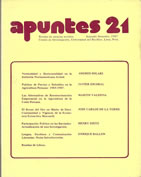
Apuntes 21
The articles in this issue: Analyze some of the trends and changes taking place in the industrial monopolistic structure of the U.S. economy; Study the evolution of agricultural price and subsidy policies implemented in Peru from July 1985, and their effects on income distribution; Examine three of the various organizational restructuring options proposed for agrarian co-operatives operating on the Peruvian coast; Review the economic consequences of the changes brought about by the gold boom in Madre de Dios; Investigate the electoral behavior of the urban poor in Lima using data from the 1985 and 1986 elections; Propose criteria for the analysis of the literary output of Peru's multilingual and pluricultural society; Provide an overview of the 8th Latin American Meeting of the Econometric Society, held in Costa Rica in 1988.

.jpg)

