
Archives
-
Vol. 15 Núm. 24 (2026): Forseti N° 24
Vol. 15 No. 24 (2026)Working from home, receiving performance bonuses, or outsourcing activities to a specialized company raise questions that are increasingly relevant in the field of law, where discussions focus on labor protections and the limits of business organization. With these concerns in mind, we are pleased to present the twenty-fourth issue of FORSETI magazine, dedicated to the challenges of labor law and social security, and also open to debate on other areas of our legal system.
-

Forseti N° 23
Vol. 15 No. 23 (2026)We are pleased to present the 23rd edition of the FORSETI Journal, which brings together a selection of articles dedicated to analyzing, from a critical and contemporary perspective, some of the most significant challenges facing contemporary law. This issue addresses key topics such as public procurement, public-private partnerships, infrastructure, consumer protection, and international trade, with a particular emphasis on the need for the legal system to evolve and adapt to the new dynamics of economic and administrative law.
-

Forseti N° 22
Vol. 14 No. 22 (2025)La Revista Forseti tiene el agrado de presentar su edición número 22, dedicada al estudio de la compleja relación entre el Derecho, la Tecnología y la Justicia. Esta publicación es resultado de un proceso editorial complejo en el que confluyeron aportes de autores y revisores de reconocido prestigio, cuya labor ha permitido consolidar un espacio de reflexión jurídica sobre algunos de los problemas más relevantes de nuestro tiempo.
-
Forseti No. 21
Vol. 14 No. 21 (2025)We are pleased to present the twenty-first edition of FORSETI Law Review, which brings together a selection of articles dedicated to exploring some of the main contemporary legal issues. This edition offers a critical look at tax, customs and environmental issues, with special emphasis on the challenges faced by the legal system to reconcile administrative efficiency with the legal security of those administered.
-

Forseti N° 20
Vol. 13 No. 20 (2024)Nos complace presentar la edición número veinte de la Revista FORSETI. Esta edición reúne una colección de artículos que abordan distintos temas de importante relevancia en la actualidad jurídica en diversas ramas del derecho como son el ámbito civil, regulatorio, internacional y del arbitraje.
En nombre del equipo FORSETI, expresamos nuestro profundo agradecimiento a todos los autores, revisores y lectores por su continuo apoyo. Estamos seguros de que esta edición se convertirá en un valioso recurso para su estudio y que contribuirá a los distintos cuestionamientos que existen en los temas presentados.
-

Forseti N° 19
Vol. 13 No. 19 (2024)It is an honor to present the nineteenth issue of FORSETI Magazine. This represents a significant milestone in our ongoing commitment to academic excellence and the provision of cutting-edge legal excellence and the provision of cutting-edge legal knowledge. The current carefully curated issue focuses on the crucial topics of
regulatory law, arbitration and information freedoms. The importance of The importance of these topics today cannot be underestimated, as they directly impact business decision business decision making, commercial disputes and the shaping of government policy government policies. -

Forseti N° 18
Vol. 12 No. 18 (2023)t is with great excitement that we are pleased to present the new edition of FORSETI. This edition is very significant, as it commemorates the celebration of the tenth anniversary of the founding of our beloved magazine.
Each of these articles is a reflection of the essence that defines us and motivates us to continue: the desire to share quality legal content and create a positive impact on society. This edition represents the collaborative work of our entire alumni association over time, with which we remember every challenge overcome and every courageous step that has brought us this far. It has been ten years of dedication and devotion to the dissemination of knowledge and the promotion of dialogue between great speakers.
We express our most sincere gratitude to all those who have been part of this beautiful road, to the authors, to the peer reviewers, to the members of the Advisory Board and the Editorial Board, and a special thanks to our Law School, which has given us its support since 2013.
We are deeply pleased to look back and see the road travelled. And with the same enthusiasm we look to the future, confident that FORSETI will continue to grow as a Journal.
This Anniversary Edition contains outstanding articles on the most important branches of law, which have been addressed throughout our trajectory: arbitration, public international, criminal, tax and customs.
On behalf of the FORSETI Team, we hope this edition will be a success.
-

Forseti N° 17
Vol. 11 No. 17 (2023)Tenemos el agrado de presentarles el nuevo número de la Revista FORSETI, primero del año 2023, abocado al Arbitraje, el Derecho Constitucional y el Derecho Internacional.
Nos complace empezar la edición 2023-1 con un tema relevante pero poco abordado: los costos derivados del arbitraje. Los autores enfatizan en el alto valor monetario que conlleva el acceder a un mecanismo de resolución de disputas de calidad y en diversos conceptos relacionados como la responsabilidad de los costos, los límites que los mismos abarcan, entre otros. Así, se puntualiza en las decisiones de los tribunales arbitrales y la necesidad de que interioricen en el análisis con respecto a los costos en los que se incurran.
Seguidamente, indagaremos en un análisis sobre el nuevo conjunto de reglas emitido por el CIADI (Centro Internacional de Arreglo de Diferencias Relativas a Inversiones) acerca de la mediación. De esta manera, el autor enfatiza en los principales cambios, con respecto a las anteriores reglas, sobre aquella forma de resolución de conflictos. Además, se explican los principales aportes de las nuevas reglas del CIADI y las mejoras que aquello implicaría en la relación entre el Estado e Inversionistas cuando se encuentren inmersos en una disputa.
Por otra parte, nos adentraremos en una revisión acerca de la protección de los derechos fundamentales de la mujer y su evolución con el paso del tiempo. En este artículo, el autor expresa, desde una mirada que abarca acontecimientos históricos, los principales motivos que condujeron a la discriminación y postergación de las mujeres. Asimismo, se abarca el reconocimiento de los derechos en diversos ámbitos, lo cual da paso a entender las medidas introducidas progresivamente para incentivar un trato similar respecto de los hombres.
Por último, concluimos con una investigación acerca de la conexión entre diversos conceptos vinculados al derecho internacional público y el derecho internacional privado. Entre los mismos, los autores se concentran en la influencia del orden jurídico internacional sobre el orden público internacional, así como también en los alcances involucrados. Así, la explicación previa toma lugar en el plano de la relación entre los dos ámbitos del derecho mencionados en el comienzo. En esta ocasión, el análisis añade un estudio de la legislación interna peruana acerca de la materia.
En nombre del equipo FORSETI, deseamos expresar nuestro más profundo agradecimiento a todos los autores y a quienes fueron partícipes de nuestro proceso de revisión de pares. Esperamos que esta edición sea de su agrado.
-
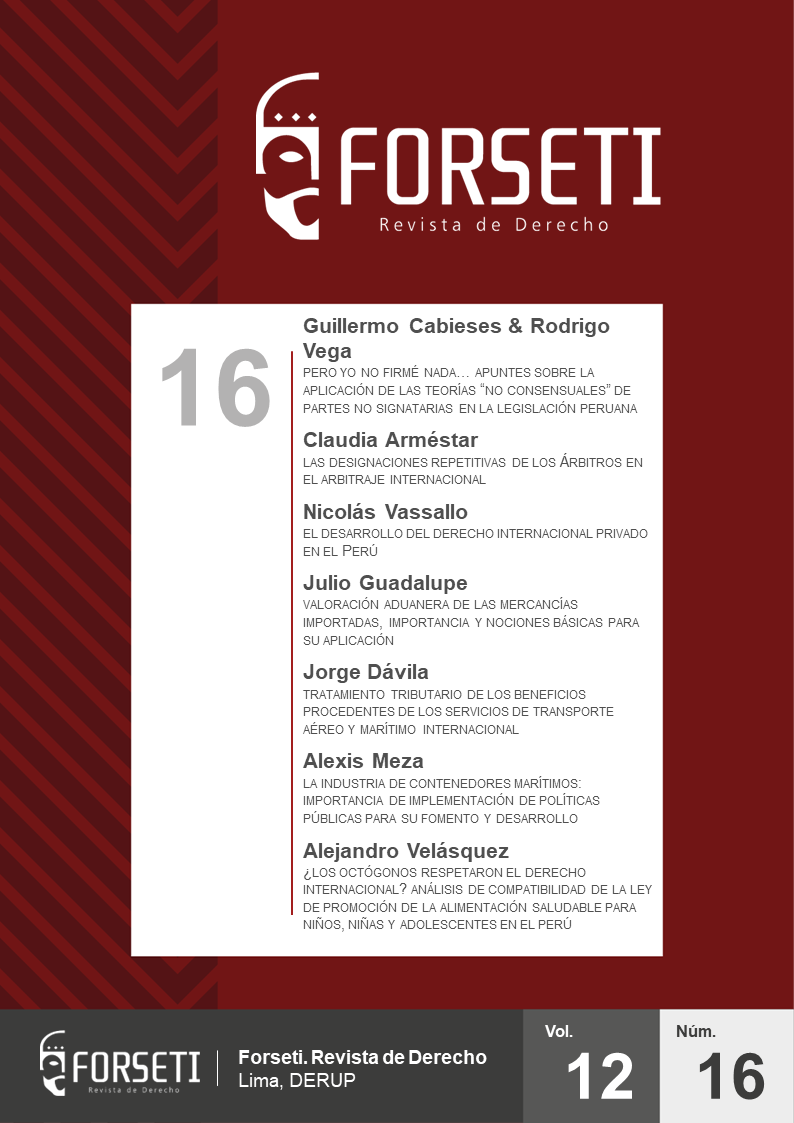
Forseti N° 16
Vol. 12 No. 16 (2022)Tenemos el agrado de presentarles el nuevo número de la Revista FORSETI, segundo del año 2022, abocado al Derecho Internacional.
Nos complace empezar la edición 2022-2 con un profundo análisis de las teorías “no consensuales” para la incorporación de partes no signatarias a un arbitraje. Los autores buscan dilucidar si dichas teorías realmente merecen una categoría independiente a la luz del derecho peruano.
Seguidamente, conoceremos detalladamente el tema de las designaciones repetitivas de los árbitros y como ello impacta en su deber de independencia e imparcialidad. Por ello, la autora enfatiza la aplicación de un análisis cualitativo y no uno cuantitativo, y presenta los criterios que han aplicado las instituciones arbitrales más importantes a nivel internacional, que son útiles para el arbitraje en el Perú.
Ahora bien, otro tema relevante es la evolución del Derecho Internacional Privado en Latinoamérica y su codificación en el Perú. De esta manera, luego de un análisis del Derecho Comparado, el autor discute la necesidad de cambios en el ordenamiento peruano.
Por otra parte, nos adentramos en la valoración aduanera, que constituye aquella metodología que permite determinar la base imponible para el cálculo de los tributos de importación. En este artículo, el autor expresa que su complejidad es la causa de diferentes interpretaciones tanto de parte de la Autoridad Aduanera como de los importadores y que ello podría generar importantes y cuantiosas contingencias.
Posteriormente, revisaremos el tratamiento de las rentas procedentes de los servicios de transporte aéreo y marítimo internacional, obtenidos por entidades no residentes, para efectos del Impuesto a la Renta. Particularmente, el autor analiza el concepto de “beneficios” a que se refieren los acuerdos para evitar la doble imposición suscritos por el Perú bajo el modelo de convenio de la OCDE; y la Decisión No.578 (CAN).
Por otro lado, comprenderemos más sobre la industria de contenedores marítimos. Así, el autor explica que, si bien existe un marco legal habilitante, son necesarias modificaciones e implementaciones de políticas públicas en beneficio de dicha industria.
Por último, concluimos con un análisis jurídico acerca del cumplimiento del Perú del Acuerdo OTC de la OMC al elaborar una serie de reglamentos técnicos en materia de salud aplicables a alimentos conocidos como “los octógonos”.
En nombre del equipo FORSETI, deseamos expresar nuestro más profundo agradecimiento a todos los autores y a quienes fueron partícipes de nuestro proceso de revisión de pares. Esperamos que esta edición sea de su agrado.
-

Forseti N° 15
Vol. 11 No. 15 (2022)We are pleased to present the new issue of FORSETI Magazine, the first of the year 2022, devoted to criminal, corporate, financial and tax law.
This miscellaneous publication covers topics never published in the journal. Although these branches have not been frequently dealt with by the product of our association, through this edition we take the opportunity to reiterate the commitment assumed by all the members of the magazine: to share the Law from all its edges, seeking to address more and more elements of the occupation that brings us together in a heterogeneous and professional manner.
In this sense, we are pleased to begin with an in-depth analysis of the substantive and procedural aspects of the autonomous criminal liability of legal entities. It also highlights the consequences that this means for the company as a subject of imputation, its limits in the permitted risk and the applicable sanctions.
Likewise, the importance of discussing the criminal liability that could be assumed by the founding partner of a company in the event of criminal conduct by its administrators is highlighted, as well as the main criteria to be followed in an eventual imputation of liability.
Another relevant issue is the importance of the Business Judgment Rule to protect the business discretion of the directors and managers of peruvian corporations. In this way, such jurisprudential rule will prevent a judge from determining the level of care of the administrator based on the economic result of his decisions, safeguarding the presumption of his diligence as long as exists bad faith, conflict of interest, lack of information or extra procedural actions are not proven.
On the other hand, we review the doctrine of best efforts in corporate and financial contracting, pointing out that this American and English practice, despite having been developed in Anglo-Saxon practice, can be equally understood in civil jurisdictions. Thus, we reiterate the need for the corporate lawyer to know the Anglo-Saxon contractual models, the national contract law (Civil Code) and to have the necessary expertise to make them dialogue and navigate between them.
Finally, we conclude with a perspective on the deduction of social responsibility expenses for income tax purposes. Thus, the need to regulate as deductible certain expenses incurred by legal entities engaged in the extractive industry to maintain a cordial relationship with peasant populations is expressed.
On behalf of the FORSETI team, we would like to express our deepest gratitude to all the authors and to those who participated in our peer review process. We hope you enjoy this journal. -

Forseti Nº 14
Vol. 10 No. 14 (2021)A criterio del gran historiador Jorge Basadre, la existencia del hombre cambió irrevocablemente con el advenimiento de las primeras ciudades, acompañadas por la formación inicial del Estado que conocemos hoy. Este se caracterizó por otorgar una primera identidad y sentido de pertenencia. En el Perú, este sentimiento se acentuó con la proclamación de independencia que -como bien sabemos- nos reafirmó como sociedad, pero exigía una nueva filiación después de casi 300 años bajo el yugo español. Por este motivo, el mes de julio representa la renovación de la promesa patria que forjó el inicio de esta etapa.
En ese contexto, hemos sido testigos de la evolución de la era republicana. No obstante, debemos reconocer que aún queda mucho por desarrollar. De esta manera, nos complacemos en presentar el décimo cuarto número de la Revista FORSETI. Esta Edición de Bicentenario refleja dicho espíritu de mejora, recopilando diversas propuestas de reforma para nuestra legislación. Así, siguiendo los parámetros de excelencia que caracterizan a todos nuestros números, tenemos el agrado de introducir con éxito nuestra primera convocatoria abierta y tercera revisión de pares.
En ese sentido, iniciando con las reformas del ámbito constitucional, se analiza el marco regulatorio de las encuestas electorales. Debido a su importancia para consolidar la democracia moderna, se debe determinar si su legislación es respetuosa de los derechos fundamentales. Del mismo modo, se cuestiona la legitimidad de las prerrogativas procesales penales con respecto a los altos dignatarios estatales. Esta controversia se centra en la posible afectación a los principios constitucionales como la igualdad ante la Ley. Por otro lado, en materia de derechos de propiedad, se presenta un diagnóstico introductorio de las principales instituciones para garantizar el acceso a los predios, así como su correcta interpretación para el beneficio colectivo. De esta forma, se continúa el debate abordando la falta de un verdadero catastro predial. Al respecto, se identifican los problemas generados, brindando recomendaciones para modernizar dicho aparato. A continuación, se narra la evolución del arbitraje ante los desafíos de la actualidad y se explica su naturaleza versátil, capaz de adaptarse a un entorno dinámico. Finalmente, en el ámbito del derecho tributario, se evalúa la pertinencia de los convenios para solucionar la doble imposición que dispone el Perú en función del régimen constitucional.
En nombre del equipo FORSETI, deseo expresar nuestro más profundo agradecimiento a todos a los autores y a quienes fueron partícipes de nuestro proceso de revisión de pares. Esperamos que esta edición sea de su agrado.
-

Forseti Nº 13
Vol. 9 No. 13 (2021)Once again, we are pleased to publish the thirteenth issue of the Forseti journal. Following the lessons learned and overcoming the challenges of the previous issue, we have successfully implemented our second peer review. In this way, we are one step closer to the completion of the indexing process we are currently undergoing.
This time, our 13th edition covers various areas of law. Thus, Julio Guadalupe addresses the problems in the operational logistics of Peruvian foreign trade, which arose as a result of the COVID-19 pandemic. He also illustrates the measures adopted by the country and the challenges that remain to be faced.
On the other hand, in the field of environmental law, Vito Verna highlights the nature and importance of the Environmental Impact Study. In addition, he addresses the problems presented by the SEIA in terms of introducing changes and improvements, as well as the shortcomings of its cross-sectoral environmental regulation.
From the point of view of Human Rights, Martin Gallardo exposes the most important historical facts about the international regulation of transnational corporations. Subsequently, he contributes to the discussion consisting in determining the appropriate regulation in this area; therefore, he proposes the alternative of a multilateral treaty that seeks to grant greater guarantees to individuals.
Regarding Constitutional Law, Gonzalo Monge makes an introductory analysis in order to contribute to the study on the treatment of constitutional duties. In this way, the author highlights their essential character for contemporary constitutionalism, as well as their legal and jurisdictional enforceability.
On the subject of arbitration, Angela Cámara and Daichi Yano comment and analyze the phenomenon of double-hatting and its implications on the duties of independence and impartiality of arbitrators, specifically in the context of investment arbitration. The purpose is to propose some guidelines for its regulation.
Finally, we express our deepest gratitude to all our members, to the authors and to those who participated in our peer review process. We also hope that this edition will please all our readers.
-

Forseti Nº 12
Vol. 8 No. 12 (2020)We are pleased to publish the twelfth issue of Forseti magazine. This edition will mark an important milestone in the development of our magazine, as it is the first edition to have a peer review process. In this way, our articles will be able to be adapted to the highest academic standards in order to comply with the indexing process we have been working on.
On this occasion, our 12th edition covers various areas of law. Thus, starting with the subject of arbitration, Gustavo Paredes develops a definitive answer as to who benefits from the loopholes in construction projects, hoping to simplify the discussion and its consequences. On his part, Juan Manuel Loza, analyses on the motivation of the evidence in local arbitration, specifically, in construction arbitrations; in which he highlights the importance of motivation as one of the aspects that contribute to improve the quality of the awards. Next, Nicolás Serván comments on the need for transparency in arbitration and proposes a series of measures to balance this aspect with confidentiality, an essential characteristic of arbitration.
On the subject of consumer law, Daniela Supo and Víctor Hugo Bazán comment on the implications and characteristics of the duty of information, with the aim of promoting its application from the point of view of the consumer's implicit guarantees and, eventually, obtaining objective decisions that are consistent with reality.
With respect to tax law, Raúl Campos and José Julio Hernández discuss the modification of the thin capitalization regime, which is one of the most important tax reforms of recent years. In this way, the authors carry out an evolutionary and comparative analysis of the rules that regulate the regime, with the purpose of developing its application in Peru, especially, in the economic context that the country is going through.
-

Forseti Nº 11
Vol. 8 No. 11 (2020)On this occasion Forseti reaches its readers on a different date than we are used to. We have abandoned our classic July-December semester publication to inaugurate now our January-July semester publications, as for the indexing process we have started to keep Forseti with the highest academic standards.
This time our 11th edition is mainly devoted to regulatory law. This leads us to have articles on construction law, administrative law in general, and electricity law, among others.
Thus, in our first article, Eduardo Ramos makes a statement regarding distributed generation and analyzes the guidelines to be followed for its correct implementation in the Peruvian legal system. Next, Alejandro Manayalle and Francisco José Floríndez question and examine the need for the merger control procedure in the electricity sector. On the other hand, Milagros Mutsios develops the characteristics of the right to prior consultation and proposes alternatives for its effective and efficient application in the electricity sector.
Likewise, Giancarlo Vignolo develops the problem of the legal nature of the mandates of the regulatory bodies and concludes that they are non-regulatory administrative acts. On her part, Milagros Maraví performs an analysis of the power of inspection that corresponds to OSITRAN from the point of view of the TUO of the Law of General Administrative Procedure. Additionally, Andrea Morelli and Luis Fernando Roca commented on the legal nature of interconnection mandates, emphasizing the way in which these are challenged and the change in OSIPTEL's position.
Subsequently, Daniela Supo and Ana Ximena del Rosario show the application of the amendments to the Law of General Administrative Procedure in the procedures of consumer protection in INDECOPI. Finally, Leandro Garcia elaborates on the connection between engineering and law by explaining the importance of Building Information Modelling (BIM) in the field of public works.
We, the members of the Journal, hope that this new issue will be to the liking of all our readers. Likewise, given the quality of our authors, we trust that this edition will be useful to enrich legal knowledge.
-

Forseti 2019-I
Vol. 7 No. 10 (2019)We are pleased to present the new issue of Forseti Law Review, our tenth Review. On this occasion we bring you a variety of articles focusing on the procedural rules of arbitration. Among them, a comparison between the IBA's rules of evidence and the new Prague rules, the arbitral Discovery procedure and the organization of an Ad Hoc arbitration by the arbitrators. In addition, we have an article on the diffuse control in arbitration based on the guidelines of the Constitutional Court and another on the arbitrability of intellectual property matters. Finally, in this edition we have an article on investment arbitration and an paper on expiration and legal certainty.
-

Forseti 2018-II
Vol. 6 No. 9 (2018)On this occasion we are pleased to present the new issue of Forseti Law Review, the eighth completely virtual Review that we publish, after the pleasant experience of having published a completely unpublished by the tenth anniversary of our Faculty at the Universidad del Pacífico. This issue brings us a variety of articles focused mainly on financing, resource mobilization and technological development, which has taken place in that market, known as Fintechs. We also have two articles related to tax law and an article translated into Spanish by two former members of our Journal of Immigrant Law in the United States.
-

Forseti 2018-I
Vol. 6 No. 8 (2018)This edition means our first edition of the Review in physical format with completely unpublished articles. A dream come true, fruit of the joint work of all our student association. Fulfilling this challenge that allows us to reach, for the second time, the hands of our readers, inspired on this occasion by a special reason, the anniversary of the Faculty of Law of the Universidad del Pacífico. This Anniversary Edition contains outstanding articles from various branches of law: financial, corporate, tax, arbitration, labor and natural resources.
-

Forseti Nº 7
Vol. 5 No. 7 (2017)In this opportunity we are pleased to present the first issue of the year 2017 of the law magazine FORSETI, which covers topics related to Corporate Law, Aeronautics, Regulatory and Arbitration.
We chose these topics for a number of reasons. In the first place, since they are of great importance in the current legal situation. In this respect, there are no commercial operations in the world in which the mentioned topics do not have any type of incidence. Therefore, we consider that the fact of freely expanding the knowledge of experts on the subject with respect to them is a way of having a positive impact on society.
In addition to the above, given the growing need for legal aid, offering an edition with multiple relevant topics for lawyers throughout the country implies that we not only actively participate in its growth, but also grow as responsible professionals.
-

Forseti Nº 6
Vol. 4 No. 6 (2016)In this edition, we are pleased to present the first virtual issue of 2016 dedicated to Constitutional Law and Human Rights.
This topic was chosen for many reasons. First, given the international situation, we consider it important to dedicate an in-depth study to such elementary subjects of law as constitutionality and human rights. In spite of the constant discussion and controversy on the matter, both matters are the minimum guarantees of any human being and democratic State. Likewise, they are the basis of all other subjects of Law. In order to understand them, they must be clearly explained.
-

Forseti Nº 5
Vol. 3 No. 5 (2015)This edition marks FORSETI's fifth publication and the last of the year. This project, which began as a simple dream of a small group of students at the University of the Pacific School of Law, has become a true example of what teamwork and a passion for a career can achieve.
In this sense, this issue is personally special, as it bids farewell to the last of the founding members, who more than three years ago set out to leave their mark on the university and set the goal of creating an institution that is sustainable, social and based on values.
It is on the basis of the objectives set, that to this day, it is indisputable that FORSETI, more than a magazine, has become a family.
Having mentioned the importance of this edition, we decided to set Foreign Trade Law and Intellectual Property as a theme. Thus, in our first article, Julio Guadalupe presents us with an analysis of the impact of royalty payments on the customs value of imported goods. On the other hand, Marta Fernández reflects on franchises as tools for the growth of brands. For her part, Vanessa Heller, who deserves special thanks for her advice in the creation of this edition, develops a detailed and precise commentary on access to the WTO dispute settlement mechanism with respect to developing countries.
Next, Javier Duany provides an analysis of what happens when trademark law is exhausted and the effects that this may entail. Next, Adriana Cristina Alegrett contrasts the difference in import restrictions in the Andean Community with respect to their treatment in Mercosur. At the same time, Enrique Cavero explains the concept of originality in Peruvian copyright.
On the other hand, Jaime Dupuy develops an analysis on compulsory licensing of pharmaceutical products and its relationship with international trade agreements. Óscar Vásquez also presents a view on letters of credit and other means of payment in international trade. In regulatory matters, Alvaro Gutiérrez offers proposals to promote and unlock investments based on the case of the health regulatory sector. Based on the recent pronouncements of the tax court, María Cecilia Pérez comments on the application of the most-favored nation clause.
To conclude with our doctrine section, Fernando Liendo analyzes the possibility of applying the originalist interpretation of the constitution according to Antonin Scalia, in Continental Law, which is worth emphasizing is of special importance in relation to judicial activism, taking into consideration the ruling on homosexual marriage in the United States. Likewise, we are pleased to have Ronnie Farfán's article, in which a detailed development of the regulation of administrative resources in the Peruvian administrative legal system is carried out.
In our jurisprudence section, we include two judgments of the Constitutional Court. In the first, it is established that in any constitutional process, the plaintiff is obliged to present a copy of the contested resolutions as minimum indispensable evidence. Otherwise, the party's litigating attorney would be exposed to a sanction. In the second, the Court conducts an analysis of the pertinence of the constitutional route and indicates that in any process of protection, where the rules indicated are applicable, the respective period must be allowed for the defendant to claim his rights.
The future of FORSETI is in the hands of its new members and we know that they are more than ready to give you, dear reader, the best of themselves.
FORSETI, always one step ahead.
Translated with www.DeepL.com/Translator
-

Forseti Nº 4
Vol. 3 No. 4 (2015)The publication of this issue marks a special milestone in the history of FORSETI. As faithful believers in innovation and the interdisciplinary study of law, we have re-launched our website, including the FORSETI JOURNAL, a new publication format that will make the most important national and international news available to both university and professional audiences.
In this sense, in honor of such an important event, with this issue we have covered two branches of the right of incidence both economic and social, especially in Peru, such as Environmental Law and Natural Resources.
The first article of this important edition, written by Francisco Tong González, deals with mining regulation and its social impacts on the country, suggesting that the rules be clear to encourage investment. On the other hand, Luis Felipe Huertas del Pino makes an analysis of Resolution 21-2014-OEFA-TFA-SEP1, of great importance for this publication, since it sets a precedent of obligatory observance related to the regulation of environmental pollution. In another line, Richard Inurritegui presents a commentary on the current fisheries regulation.
On the other hand, Juan Pablo Macassi Zavala presents an interesting aspect of mining activity, focusing on the forest trust as a guarantee for the closure of mines. Eduardo Ramos Arechaga also provides a detailed article on the hydrocarbon industry in the country. Andrés Talavera C. and Manuel Ferreyros, for their part, introduce us to petroleum lex and its possible application in Peru. To conclude with this thematic section, Fabiola Capurro points out what should be Peru's agenda for sustainable environmental development.
As always, this edition has a miscellaneous section and on this occasion we have had the participation of Fernando Cuadros Luque and Sergio Quiñones Infante, who through an economic and legal analysis, make a comment about the debate on the increase of the minimum vital remuneration. Likewise, and on the more traditional but equally important side, Alfredo F. Soria Aguilar, presents us with an article about the ineffectiveness of the juridical act.
We could not end our presentation without first thanking all the speakers and guests at our events, which not only contribute to our personal academic growth, but, through their presentations, succeed in enriching the academic discussion both in our Faculty and in our university, always encouraging interest in the rights of members of other careers.
Finally, we thank all our members, former members and collaborators without whom this edition would not have been possible. FORSETI, beyond being a magazine, has become a family. In these three years of operation, we have had the opportunity to raise new projects and face different challenges. It is our commitment to you, Mr. Reader, to give you the best of us in the future.
FORSETI, always a step forward.
-

Forseti Nº 3
Vol. 2 No. 3 (2014)Dear FORSETI readers,
On this occasion we are pleased to present the second issue of the 2014 law journal FORSETI, which has as its main theme the civil patrimonial law.
We chose this central theme for a number of reasons. First of all, of course, the thirtieth anniversary of our Civil Code has undoubtedly been one of the main reasons that encouraged us to make our contribution to the subject.
However, this is in addition to the fact that, as a natural source of consultation, we required an issue that highlights our quality as a law journal in general. What better way to do this than by contributing to the study of legal relations between private individuals. Finally, the private ones are the real engine of our economy and the basis of our constant growth as a country.
This edition constitutes a synergy between experienced lawyers, young promises and even students. Thus, first of all, Marco Antonio Ortega presents us with a complete analysis of the object of contracts, analysing the implications of the conventional method of transfer of ownership.Guillermo Arribas, for his part, focuses his interest on questioning hidden vices and their recovery. In the matter of real rights, Martín Mejorada analyses the prohibition of mortgaging future goods, and comments on how some future goods are in reality present rights. The article gives as a main example the commercial activity of real estate companies at the time of launching their projects; and how the acquirers demand a higher and higher level of opposability. Raúl Ravina, from the recent modification to the Civil Code in the matter of possessory defense, criticizes how the content of such modification could eventually allow possessory defenses after a long time has passed since the loss of possession.
Next, Luciano Barchi offers us important reflections on the regulation of prescription in our Civil Code, making a comment in relation to the same figure in other legislations. He also devotes his article to explaining the raison d'être of the prescription and its nature. Renzo Saavedra, for his part, explains the relationship between rights and legal remedies. Next, Luis Miguel Velarde and Fernando Ikehara, as co-authors, draw attention to the problems related to compensation for civil damages in criminal cases, explaining that the commission of a dangerous crime should not always lead to compensation. Likewise, the authors criticize (and later propose) the method used to calculate the compensatory amounts.
On the other hand, Jose María de la Jara gives us a psychological view of the existing biases in our judges when applying the requirements for the configuration of the attribution factor and the damage in civil liability matters.
In our miscellaneous section, Juan José Martínez conducts a correct review of trusts in public administration, and their current situation. He also presents a series of proposals that would lead to improved legislation.
As is customary in FORSETI, we present a research work carried out by Brenda Gatica, Franco Gratta and Andrea Limón, in which they explain the so-called "anchoring" effect in the negotiations from a perspective of law and psychology.
Finally, we also present four jurisprudences that we consider have had repercussions due to the relevance of their content. Among them, the new pronouncement of our Constitutional Court stands out, revoking the possibility of the administration to carry out diffuse control. The same collegiate, in another pronouncement, protects the property rights affected by the closure of the Monumental Stadium. In third place, a resolution of the Superior Court is presented that delimits the legal nature of a bond and a civil bond. Finally, the supreme court argues the reasons why the criminal action interrupts the statute of limitations.
Without prejudice to the quality of our authors, who logically make this edition a substantial contribution to the legal community; we wish to dedicate this introductory section to the impact that FORSETI represents.
The 30 people who make up FORSETI today are convinced of the central importance of being a source of reliable, quality and free academic content.
We were the first to succeed in consolidating, organizationally and economically, an association that does not discriminate among its users. Anyone with Internet access can access the full content of our publications, without restrictions of any kind, completely free of charge. We are convinced that all this will help the educational development of our country.
On the other hand, we also organize, twice a year, quality legal events, free of charge. In them, the interaction with the most important lawyers, judges, congressmen, businessmen or academics of other disciplines is possible for anyone interested in the subject. We invite you to follow our web content closely, so as not to miss any of our future events.
Finally, we would like to thank all the members of the FORSETI family. Without the constant work of each one of you, this project would not be a reality today. This thanks is mainly to the current members, but it extends to those who left; but especially to those members who will come. We leave you with a magazine that leaves its mark.
FORSETI, always one step ahead.
-

Forseti Nº 2
Vol. 2 No. 2 (2014)For the second time I have the joy of being able to welcome you to the virtual publication Forseti. From this publication on, each of our issues will revolve around a branch of law. On this occasion we chose the natural method of resolving international commercial disputes: arbitration. This statement is echoed in several articles in this issue.
The first article of this publication is by Emmanuel Gaillard who does not deserve further presentation, explaining the different visions or representations on international arbitration. It affirms on the basis of the 1958 New York Convention that arbitration is a transnational system of justice and an autonomous legal order. This article is compulsory reading for all those who want to know the philosophical bases that inspire international arbitration and the practical consequences derived from representations.
Once I have read this article, I immediately recommend that I turn to the article by Fernando Cantuarias and Jose Luis Repetto, which comments on the theories on the legal nature of arbitration and analyzes the deficiencies of the theory adopted by Peru. In the opinion of the authors and to the extent possible, the Peruvian Constitutional Court should adopt the theory that the civilized world gathers in the matter of arbitration.
If you want to read about specific topics of international commercial arbitration, this issue of Forseti offers three articles on the extension of the arbitration agreement to non-signatory parties. A controversial, debatable question, and in the words of Professor William W. Park, a dilemma for arbitrators. I recommend starting with this article, which comments in a general way on the theory of extension from the point of view of consent and the lifting of the corporate veil.
Landing in Peru, Roque Caivano and Verónica sandler analyze the stipulation in favor of third from the Peruvian law in arbitral matter. Jose Luis Repetto, Andrés Hundskopf and Miguel Valderrama analyze another theory of incorporation of non-signatory parts: the lifting of the corporate veil or alter ego and comment on a well-known Peruvian jurisprudence that can also be found in this edition of Forseti.
Another issue of vital importance in international arbitration is the annulment of the award and its recognition and enforcement before the courts. Mario Reggiardorealizes a complete analysis of the causes of annulment of the arbitral award in Peruvian law. Pablo Mori and Julio Olórtegui comment on article V(1)(a) of the
New York Convention. For their part, Andrea Jiménez and Yamila Reinides tackle a complex, controversial and current problem of international arbitration: the possibility of recognizing and enforcing an annulled award at the place where it was issued.
As for applicable law, Professor Jose Antonio Moreno, a Paraguayan arbitrator specialized in the matter, introduces us to the lex mercatoria and analyzes all the problems that have been generated at the international level. Alfredo Bullard and Jose Luis Repetto from a Darwinian perspective, analyze the evolutionary process of international arbitration and the interaction between the system of civil law and common law in arbitration.
Investment arbitration could not be absent in this Forseti publication. On this occasion, María del Camen Tovar analyses the so-called umbrella clause included in many bilateral investment treaties and discusses the role of domestic law, the contract and the treaty when we are faced with a controversy containing this pact.
Jurisprudence plays a transcendental role in international arbitration. On this occasion, Forseti presents to the legal community two judicial rulings and one ruling of the Constitutional Court.
In this issue of Forseti you will find the judicial decision of the Superior Court that ends the discussion of the well-known TSG case. In an arbitral award rendered under the repealed Law 25886 (which did not contain a provision such as that contained in the current article 14 of our arbitration law), non-signatories of the arbitral award were incorporated by application of the theory of the lifting of the corporate veil. This case was annulled by the Judicial Branch, and after several adventures, the Superior Court ruled on the matter. The outcome of this party can be found in this issue.
Likewise, we make available a controversial sentence of the Superior Court that declared null and void an arbitration award because a subject did not sign the arbitration agreement. In another ruling that you can also find in Forseti, the Constitutional Court upheld an arbitral award alleging improper representation of one of the parties.
The entire Editorial Committee hopes that this magazine will continue to be to its liking. And just as arbitration has become the natural method of settling international commercial disputes, so too has it become the natural method of settling international commercial disputes.
Translated with www.DeepL.com/Translator
-

Forseti Nº 1
Vol. 1 No. 1 (2013)The story goes that five friends, and later the entire Forseti team, set themselves an apparently simple goal: not to graduate from the University of the Pacific Law School without leaving a mark. We may well have passed through the University, passing all the courses, to then get a job in an important law firm or in a legal department of a company. However, we didn't think that would be fair. All the more so if we consider that our faculty is still very young.
The goal that these five friends and the Forseti team set for themselves today is achieved today. A civil association was formed to promote law through the publication of a high quality magazine and the organization of events on topics of legal relevance and topicality.
This magazine is divided into two parts. Our "Old Testament" consists of seven interesting articles. First of all, Dr. Alejandro Falla introduces us to the world of predatory pricing by state-owned enterprises. Next, Cecilia O'Neill conducts a rigorous analysis of the regulation of international leniency programs with special implications in Peru. Mario Drago and Fiorella Zumaeta, in turn, comment on Peru's system of eliminating bureaucratic barriers and how this model is very useful in developing countries.
Then, professors Carlos Zelada and Eduardo Bertoni carry out a profound jurisprudential analysis of the right to privacy through the different pronouncements of the Inter-American Court of Human Rights. Subsequently, Dr. Carlos Granda analyzes the stipulation known as Go-Shops applied in contracts for the purchase and sale of shares. Professor Oscar Sumar analyzes the implications of the enacted law on junk food, and finally Guillermo Hidalgo and Cynthia Aldazábal study the deduction of pre-operating expenses in the Income Tax Law.
The "New Testament" constitutes an analysis of the practical application of law. On this occasion we have two resolutions of INDECOPI and two judgments of our Constitutional Court.
As a first point, the resolutions of INDECOPI. We make available to all our readers the resolution of the Free Competition Commission of INDECOPI against UNACEM and other distributors, which analyzes their responsibility for the commission of vertical collusive practices (Cementos Lima Case). In the second place, the decision of the Specialized Chamber for Consumer Protection of INDECOPI that declares unfounded the appeal filed by Santillana, sanctioned for having distorted the process of selection of school textbooks (Caso Editoriales).
Regarding the rulings of the Constitutional Court, the first one involves the questioning of whether the amount received for expropriations constitutes income affects the Income Tax Law, while the second one deals with the distortion of a pre-professional practice contract.
Finally, I am fortunate to be able to welcome you to Forseti, the first academic journal edited by students of the Faculty of Law of the Universidad del Pacífico that is published quarterly on Forseti's website. Being able to write these lines means that we have come a long and complex way, but I can say that it has been worth it.
Forseti shows that a simple idea could become a reality, and that with effort, we managed to overcome what many indicated as a distant longing.
Finally, I could not end these lines without thanking those who annoyed and trusted that making a magazine was possible: Andrés Hundskopf, Sebastián de la Puente, Ernesto Cabrera and Sebastián Castro. As well as all the authors who trusted Forseti even though it was only a project. And now the challenge for all Forseti members is to keep the flame burning.
Translated with www.DeepL.com/Translator

1.jpg)
