
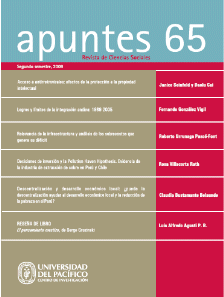
Achievements and limits of Andean integration: 1989-2005
DOI:
https://doi.org/10.21678/apuntes.65.590Abstract
This article examines the achievements and limits of the economic integration process in the Andean Community of Nations (CAN) subregion during the period 1989-2005. In accordance to the «open regionalism» approach embraced by CAN along that period, progress is assessed both in regards to the «internal agenda» and to the «external agenda» of Andean integration. Main achievements are the full completion of the subregional free trade zone and successful negotiations with the United States, the EU and Mercosur. Whereas main limitations are found in the incapability to establish a customs union among all CAN members and to conduct community trade negotiations with third countries. Both short comings reflecting difficulties yet to be overcome to duly adopt the exigent European model of integration, as well as unequal national capacities to take profit from the subregional market benefits. Reasons why CAN seems to be evolving towards and hybrid model of integration, incorporating some mechanisms inspired by US’s recent trade agreements while trying to keep the institutional arrangements of European inspiration.Downloads
Download data is not yet available.
Downloads
Published
2009-03-10
How to Cite
González Vigil, F. (2009). Achievements and limits of Andean integration: 1989-2005. Apuntes. Social Sciences Journal, (65), 31–60. https://doi.org/10.21678/apuntes.65.590
Issue
Section
Articles
License
Apuntes publishes all its articles and reviews under a Creative Commons Attribution (CC BY 4.0) license with the objective of promoting academic exchange worldwide. Therefore, articles and book reviews can be distributed, edited, amended, etc., as the author sees fit. The only condition is that the name of the author(s) and Apuntes. Revista de Ciencias Sociales (as the publisher) be cited.

.jpg)

