
Archives - Page 4
-

Apuntes 22
Empirically study the consequences of boom-bust natural-resource cycles in the presence of domestic distortions in international trade; Present a general overview of the monetary method employed by the Institute for Liberty and Democracy (ILD) to obtain a rough estimate of the scale of the underground economy; Explain how the lack of development of the financial system and its performance are closely related to the emergence and evolution of the informal capital market; Address the methodological debate on the problem of labor, emphasizing the need for empirical research, providing ethnographic data on workers and unions of the Southern Peru Copper Corporation; Examine the reasons behind the failure of the heterodox stabilization policies that were implemented by Latin American countries in the mid-1980s, in response to the orthodox anti-inflationary policies designed in economies that were experiencing chronic inflation.
-
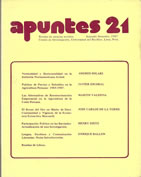
Apuntes 21
The articles in this issue: Analyze some of the trends and changes taking place in the industrial monopolistic structure of the U.S. economy; Study the evolution of agricultural price and subsidy policies implemented in Peru from July 1985, and their effects on income distribution; Examine three of the various organizational restructuring options proposed for agrarian co-operatives operating on the Peruvian coast; Review the economic consequences of the changes brought about by the gold boom in Madre de Dios; Investigate the electoral behavior of the urban poor in Lima using data from the 1985 and 1986 elections; Propose criteria for the analysis of the literary output of Peru's multilingual and pluricultural society; Provide an overview of the 8th Latin American Meeting of the Econometric Society, held in Costa Rica in 1988.
-
Apuntes 20
The articles in this issue: Identify differences and similarities between the stabilization plans of Argentina, Brazil, and Peru, as well as some reflections on anti-inflationary policies; Establish a relationship between the consolidation of Peruvian democracy and the attempts of the Belaunde government (1980-1985) to apply economic austerity programs; Study the rift within the Catholic education system in Peru, sparked by Velasco's 1972 reforms; Examine the social demand for university education in Peru at the level of individual participants in the process; Review the literature on agricultural development in Peru over the period 1968-1986, in terms of the transformation of haciendas into cooperatives and the subsequent parceling of the latter; Analyze the consistency of decision-making during the first half of the Velasco government, with reference to the Majes-Siguas irrigation project as a typical case; Focus on the emergence of various indigenous organizations in the Amazon over the past two decades, attempting to pinpoint the common axes between them and the wider society around them; Propose an epistemological and economic basis for a new conceptual framework for a general theory of economic development.
-

Apuntes 19
The articles in this issue: Review different approaches to explaining the process of economic centralization and the formation of economic groups; Analyze customs, the domestic market, and the commercial elite in Cuzco before and after the Great Rebellion of 1780, focusing on five of the most prominent merchants of the day; Analyze financial decisions and the influence of economic groups in Peru over the period 1884-1930; Discuss the different variables of analysis of the Romero economic group in Peru, from its establishment in 1890 through to 1985; Chart the formation, ascent, and decline of the family-owned Prado economic group (1890-1970), questioning whether this was an oligarchic group or representatives of a national bourgeoisie; Provide a bibliography of the history of science and technology in Peru.
-
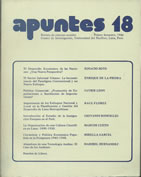
Apuntes 18
The articles in this issue: Propose a distinctive conceptual framework that emphasizes the role of the human factor in the economic development of nations; Analyze the informal urban sector, proposing a new theoretical approach to overcome the inconsistency of the conventional paradigm; Provide some guidelines to determine whether import protection is effective, analyzing relative prices to determine whether other economic sectors are seriously impacted; Examine the scope of urban planning in metropolitan Lima within the context of national, regional, and local development, proposing specific actions to ensure effective and participative solutions to metropolitan- and district-level problems; Provide an overview of European immigration to Peru, aiming at an initial analysis of previous studies in this area; Provide a social history of the emergence of modern science in Peru over the period 1890-1930; Reconstruct the socio-political and economic context in which the populist economic policy was implemented by the Bustamente-APRA government; Analyze the abandonment of the Andean agricultural technology, the case of the andenes, in the context of changes in Andean social and organizational systems.
-

Apuntes 17
The articles in this issue: Investigate the reasons for the boom in textile exports starting in the second half of the 1960s in Peru; Elucidate the characteristics of the energy crisis in Peru, putting in perspective the current debate on the issue; Reconstruct the opinions and attitudes of low-income sectors regarding the middle classes in Peru, placing special emphasis on the subjective dimension of how the social classes perceive each other; Draw attention to the seriousness of the problem of poverty in Latin America, arguing that it is not indicative of the failure of years of analysis, but rather a reflection of the inescapable need to continue devoting resources and efforts to studying and tackling the phenomenon; Argue that the unworkability of democracy in Bolivia is partly explained by the failure of political parties and civil society to perform their roles effectively. Provide an overview of studies on the history of colonial Peru in foreign journals over the period 1978-1984; Contribute to the debate on the city of Lima based on the historic reflections of César Pacheco Vélez, author of Memoria y Utopía de la Vieja Lima.
-

Apuntes 16
The articles in this issue: Analyze the role of the Peruvian state in the economy and the context in which the economy has been modernized under various governments; Review centralization in Peru and propose eleven recommendations for the implementation of regional governments in Peru; Conduct an initial evaluation of Peru’s policy of economic openness between 1979 and 1982, in relation to the industrial sector; Examine the Peruvian metalworking industry so as to evaluate the possibility of incorporating numerically controlled machine tools and determine future potential for their application; Investigate electoral trends in marginalurban areas of Metropolitan Lima during the period 1963-1983; Provide a comprehensive analysis of the composition and aims of self-defense groups (rondas campesinas) in Cajamarca; Catalog economic research in Lima over the period 1985-1986.
-
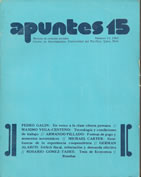
Apuntes 15
The articles in this issue: Analyze the Peruvian labor movement and its political affiliations from the start of the 20th century through to the elections of 1978, 1980, and 1983; Review technology and working conditions in the Peruvian manufacturing industry; Study forms of payment and automatic increases in the Peruvian textile industry; Study the revisionist lessons from the Peruvian experience of cooperative agriculture, and their micro-organizational consequences for cooperative production; Present a counterpoint to the liberal view in which the ineffectiveness of the public sector is the result of the actions of economic-policy actors; Provide a bibliography of Economics theses at Lima universities from 1967 to 1984.
-
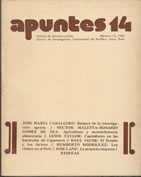
Apuntes 14
The articles in this issue: Review the unprecedented increase in research on Peruvian agriculture and campesinos in the 1970s; Analyze the problem of agriculture and foreign trade in Peru; Evaluate capitalist changes in the haciendas of Cajamarca; Employ a historical perspective to assess the results of state action in the dairy sector; Review the quantitative results of a study of micro-enterprise in Peru; Present a bibliography on Chinese immigration to Peru.
-
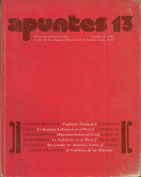
Apuntes 13
The articles in this issue: Present preliminary estimations of the Peruvian gross national product over the period 1900-1942; Analyze Italian immigration to Latin America with reference to the Peruvian case; Review Peruvian contributions to the field of labor or industrial psychology, with reference to five lines of research; Shed light on Peruvian industrialization policy over the period 1960-1970; Argue that Latin American countries will never develop, according to the current way that development is defined; Analyze the international context, actors, and lessons of the Falklands/Malvinas conflict.
-

Apuntes 12
The articles in this issue: Study the processes of urbanization and cultural homogenization in Latin America; Analyze unemployment and underemployment among intellectuals in Peru; Provide a history of the limited Italian immigration to Peru; Review the phenomenon of nationalism in the Third World; Study the oligarchy in Peru in the early decades of the 20th century; Provide a historical account of transnational and domestic capitalism in Peru and the main “cores” of accumulation (production and circulation); Analyze changes in the role of transnational corporations (both Eastern and Western) in East-West-South economic relations; Consider the importance of the context of technical-economic information and intelligence for development; Provide an economic study of the historical practice of sharecropping, challenging traditional assessments of its inefficiency.
-

Apuntes 11
The articles in this issue: Offer an analysis of Peruvian judges based on the results of two workshops on law and social change; Relate certain important developments in the framework of international economic relations, and how these affect Peru's options for its development strategy in the 1980s; Explore the development of Peruvian semiotics, which has undergone two clearly differentiated stages; Analyze the sectoral perspectives of non-traditional exports in Peru; Provide an overview of Latin American studies in Italy over the period 1960-1979, with particular reference to works on Peru; Analyze the “new international division of labor,” which transcends the traditional division of labor in which the Third World exported raw material and imported of finished goods; Examine the effects and influence that public enterprises have on the economic development of peripheral countries .
-
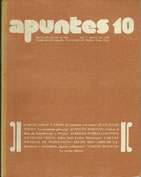
Apuntes 10
The articles in this issue: Analyze personal income tax in Peru; Study the contrasts and surprises of the Peruvian economy in 1979; Review the book Anatomía de un fracaso económico: Perú, 1968-1978 by Peruvian economists Daniel Schydlowsky and Juan Julio Wicht; Provide some reflections on Jorge Basadre’s work, Elecciones y centralismo en el Perú (Notas para un esquema histórico); Analyze the provisions for industrial action in Peru’s recently introduced labor legislation; Inquire into José Carlos Mariátegui's stance on university reform; Explore the works of the same author written under the pseudonym “Juan Croniqueur” between 1914 and 1918; and Present a previously unpublished group of Mariátegui's letters.
-
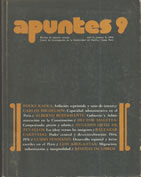
Apuntes 9
The articles in this issue: Seek to provide a framework of analysis for the economic policy measures adopted and to be adopted in relation to the interest rate; Analyze the specific role of the administrator in Peru; Present some theoretical guidelines that may be useful in preparing regulatory proposals, whether at the constitutional or legislative levels; Discuss the formation of the rural proletariat in Peru from the mid-20th century and the later emergence of rural “excess labor”; Confront the question of ideas versus images in the debate regarding Peruvian architecture; Challenge sociologist Henry Pease’s contention that the Peruvian state was directly controlled by a closed oligarchy in which agro-exporters were dominant . Explore the history of regional development and the railroads in Peru from 1850 to 1819; Present a bibliography about migration, urbanization, and marginality in Peru.
-
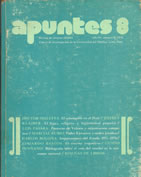
Apuntes 8
The articles in this issue: Critically examine the notion of underemployment and the underutilization of labor in Peru; Focus on the popular psychology that characterized the public acts of Haya de la Torre and other APRA leaders; Analyze the period of military reformism and campesino organization that unfolded in Peru over the period 1968-1975. Evaluate the actions of the executive branch and the structure of the legal system through the analysis of various types of decrees and resolutions; Investigate public-sector imports over the period 1971-1974; Question whether the Yugoslav system can be considered communal ; Present a bibliography of rubber exploitation and its socioeconomic consequences in Peru.
-
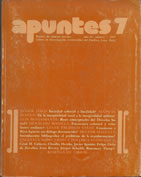
Apuntes 7
The articles in this issue: Study the Royal Treasury, one of the four major forms of political control that Spain exercised in its American colonies; Review internal migration and population dynamics in the Third World, and the difference between urban and rural living standards; Provide the preliminary bases for a doctrinal conceptualization of social law; Examine the establishment in the 17th century of a kind of Pax Andina, which would account for the absence of major Indian rebellions; Present the correspondence between José de la Riva-Agüero (1885-1944) and don Miguel de Unamuno (1864-1936), covering a decisive period in the life of the former; Analyze the economic crisis of 1975, the latest in a series in Peru ; Present a bibliographical introduction to the problem of transformation.
-

Apuntes 6
The articles in this issue: Tackle modernization and change in the wool industry in southern Peru over the period 1919-1930, in the light of recent discussions about capitalist and pre-capitalist forms of production in Latin America; Provide some general contributions on planned social change in Latin America; Seek to answer the question: what is just and what is justice?; Analyze the premise and background of the Túpac Amaru Plan for the Peruvian economy, and proceed to evaluate the plan itself; Present an initial brief analysis of a selection of Peruvian 20th century journals; Provide some comments on the books La polémica del indigenismo, José Carlos Mariátegui-Luis Alberto Sánchez, and Distribución del ingreso en el Perú; Present a brief history of the Peruvian National Library and its relationship with Peru’s universities; Critique the book Distribución del ingreso en el Perú by Richard Webb and Adolfo Figueroa with, in the subsequent article, a response from the authors; Present a bibliography on the first stage of the Peruvian revolutionary process.
-
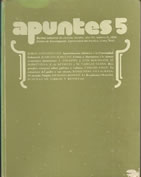
Apuntes 5
The articles in this issue: Review debates in Peru regarding the industrial community and workers’ rights; Analyze the appearance of a new political elite and the emergence of an ideology to promote its cohesion as a fundamental consequence of the Mexican Revolution of 1910-1917; Propose the hypothesis that the terms of exchange resulting from the interaction of market forces are the expression of power relations between interest groups in a social system; Describe, analyze, and critique the Delphi method, developed to find a group approach to decision-making in companies; Describe the results of a survey completed by Peruvian cultural figures to identify the links that exist or ought to exist between politics and culture; Present a bibliography that critiques orthodox economic theory.
-
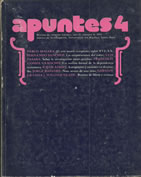
Apuntes 4
1975The articles in this issue: Seek to address certain problems of vital importance to understanding the problematics of the so-called “external sector”; Analyze Cuzco mural art from the 15th to the 20th century to explore mestizaje and its cultural expression through painting; Provide some suggestions for a formal analysis of economic dependence; Review the self-management system, as opposed to the market and statist systems, which offers an alternative for developing countries; Analyze the changing approach to socio-legal research; Present a response by Jorge Basadre to César Pacheco Vélez’s critique of his Conversaciones de Jorge Basadre y Pablo Macera.
-

Apuntes 3
The articles in this issue: Consider approaches to the study of the reproduction of capital, from the perspective of its internationalization; Analyze the state of the Peruvian economy in 1873, its sectoral evolution, the development of investment, agreements with imperialist capital, economic policy, and future perspectives; Introduces the thinking of Jacques Maritain, one of the foremost intellectuals in the dialogue between Christians and Marxists for a better political praxis; Compare the fundamental principles of agrarian policies in various Third World countries in order to understand how they work, and why they often do not work in developing countries; Analyze Decree Law 19988 on public procurement involving the Peruvian government and foreign firms; Present the results of a survey about the state of the social sciences in Peru; Present a bibliography on multinational companies between 1970 and 1973.
-
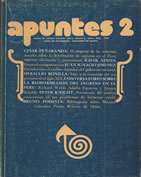
Apuntes 2
The articles in this issue: Present an analysis of the term “rural wellbeing” and the relationship between wellbeing, individual values, and analytical methods; Discuss the conditions for the successful application of the self-management model by firms, with reference to the Yugoslavian case; Examine the specificity of the regional economic history of the south of Peru, which between 1780 and 1840 underwent significant growth while the rest of the Viceroyalty suffered a severe economic crisis; Present an excerpt from the book Sistemas Administrativas by Juan Ignacio Jiménez, in which the author provides an introduction to the systemic analysis of the national government; Analyze the impact of the current reforms relating to the distribution of income in Peru; Provide a transcription of an academic conference about the redistribution of income in Peru; Present a bibliography of works about Manuel González Prada.
-
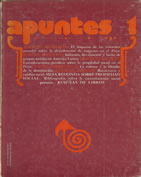
Apuntes 1
The articles in this issue: Critique the most important scholars who studied the causes of inflation in the 1960s, the monetarist and structuralist economists; Outline legal considerations related to social property in Peru; Analyze Salazar Bondy's conception of Hispano-American culture and philosophy in general and Peruvian in particular, as inauthentic due to domination; Illustrate, using the Peruvian case, some practical problems posed by redistributive policies; Explore bureaucracy, its elements, the different forms that developing countries adopt, its rationality as a political strategy, and the new theoreticians who study it; Present excerpts from a roundtable organized by Universidad del Pacífico, intended to elucidate the background and implementation mechanisms of social property in Peru; Present a bibliography on Peruvian social stratification.

.jpg)

